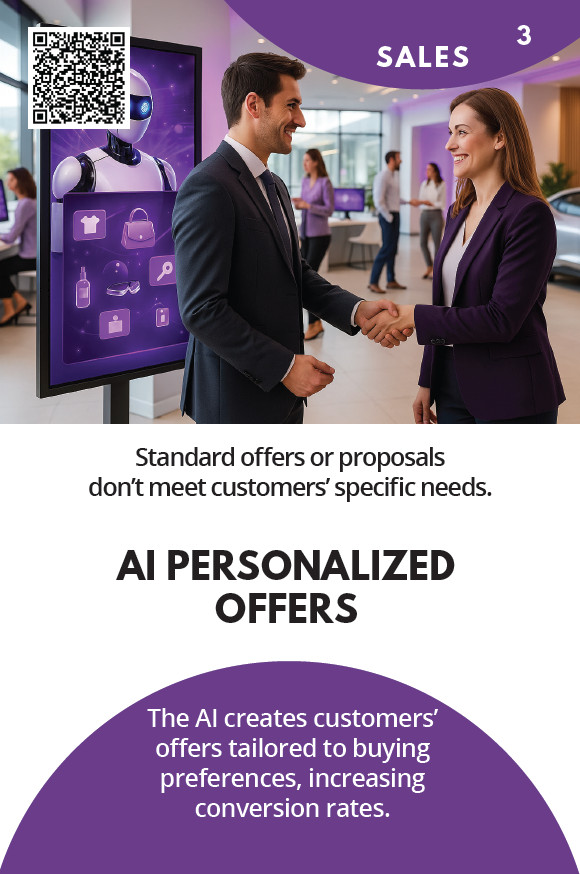
3. AI Personalized Offers
What challenge or problem does this AI solution solve?
Standardized offers often do not meet the specific needs of customers. Sales teams rely on general templates and average discounts, so many opportunities remain unused. Customers expect relevant offers that recognize their habits, purchase history, and current needs — something most companies cannot provide without advanced analytics. The result is lower conversion rates and loss of loyalty.
Why does AI solve this problem best?
Traditional CRM systems track purchase history, but they do not understand customer behavior or predict future needs. AI technology uses predictive analytics and generative models to analyze behavior patterns, customer value, and the current communication context. Unlike manual segmentation, AI automatically creates micro-segments and personalized offers that maximize the likelihood of purchase. This approach delivers results beyond the capabilities of traditional marketing and sales.
How does AI solve this challenge or problem?
This AI solution:
- analyzes purchase history, website behavior, and reactions to previous offers,
- predicts the customer’s next interest or need,
- automatically creates and sends offers tailored to individual profiles,
- suggests cross-sell and up-sell options based on data,
- tests different variants (A/B testing) and learns from campaign results,
- connects with CRM, email, and e-commerce systems so that offers are automatically updated.
In this way, companies can create thousands of unique offers per day, fully automatically and with a higher degree of relevance than ever before.
What are the concrete benefits for the company?
Implementation of this AI solution delivers measurable results:
- 20–40% higher conversion rate,
- 10–25% increase in average order value (AOV),
- greater customer loyalty and reduced churn,
- time savings in preparing offers and campaigns of up to 50%,
- a personalized relationship with each customer based on the relevance and timeliness of the offer.
The AI approach enables building customer relationships based on understanding, rather than on a generic approach.
Required data sets
To create this AI solution, the following data sets are needed (recommended):
- CRM: history of offers, customer reactions, transaction value, purchase frequency.
- ERP: inventory levels, product availability, current prices, and delivery deadlines.
- Marketing data: audience segmentation, campaign results, website and app behavior.
- Customer support (optional): feedback and frequently asked questions.
This data enables the model to generate offers that are contextually relevant and optimal in timing.
Elements for ROI calculation
CAPEX (investment):
- development and training of the AI model,
- integration with CRM and marketing platforms,
- licenses and API costs,
- initial training of the sales and marketing team.
OPEX (costs):
- cloud infrastructure costs and model maintenance,
- system updates and retraining,
- performance monitoring and ethical controls (bias and validation).
KPI (success indicators):
- Increase in offer acceptance rate (% Accepted Offers).
- Increase in average basket / order value (AOV – Average Order Value).
- Precision of segmentation and personalization (Precision@K, Recall@K).
- Reduction in time needed to create an offer (min) — CRM task delta measurement.
- Improvement in repeat purchase rate (%) in the personalized segment.
Average ROI for this AI solution
- Return on investment: 60% – 160%
- Time to ROI: 4 – 9 months
- Best for: online retail, banking, insurance, telecom, SaaS companies, media platforms, streaming services, travel agencies, loyalty programs, fintech companies
How do you choose and implement the right AI tools?
2-day training for preparing the implementation of business AI solutions