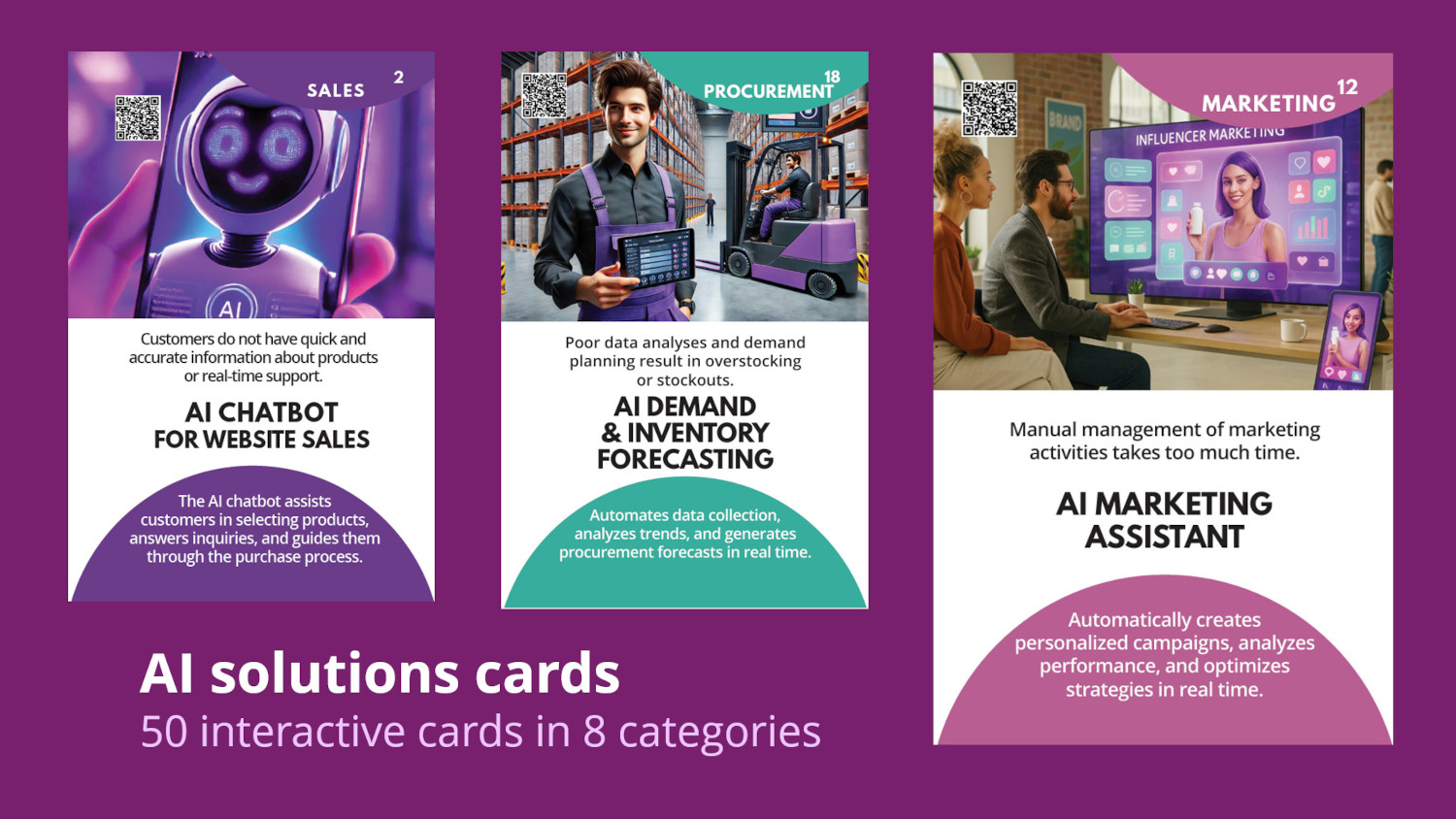
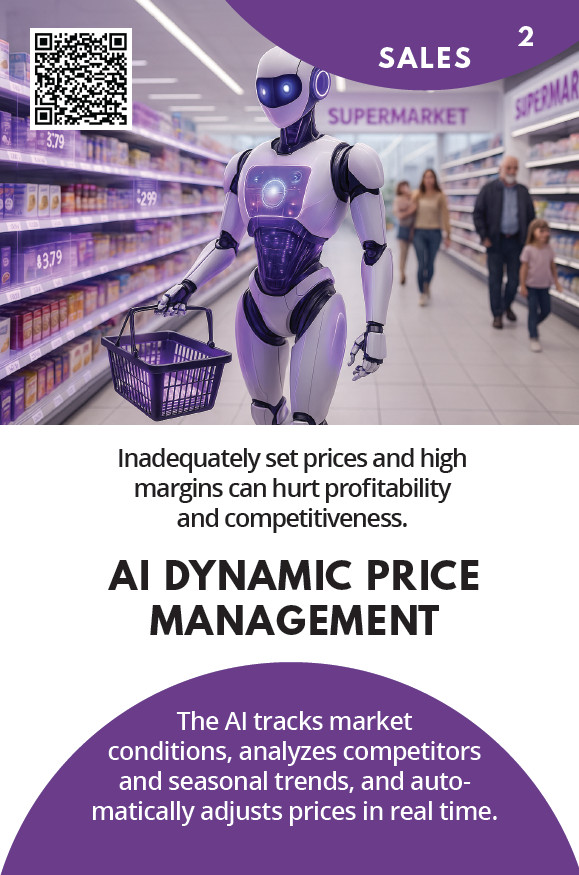
2. AI Dynamic Price Management
What challenge or problem does this AI solution solve?
Many companies still define prices manually, too slowly, or based on outdated assumptions. As a result, they often miss revenue opportunities, react too late to market changes, and struggle to balance profitability, competitiveness, and inventory turnover. Static pricing models and delayed decision-making can lead to lower margins, lost sales, overstock, or reduced customer loyalty when prices are not aligned with real demand, competition, or customer behavior.
Why does AI solve this problem best?
Traditional pricing rules are usually too rigid to respond quickly to changing business conditions. They cannot continuously analyze multiple variables at the same time — such as demand, competitor prices, seasonality, stock levels, customer segments, and purchase history. AI Dynamic Price Management uses predictive analytics, machine learning, and real-time data processing to detect pricing patterns, forecast customer reactions, and recommend or automatically apply the most effective pricing decisions. This enables a speed, precision, and adaptability that manual pricing or fixed-rule software cannot achieve.
How does AI solve this challenge or problem?
AI Dynamic Price Management continuously analyzes internal and external data in order to recommend or implement the optimal price at the right moment.
- monitors changes in demand, competitor prices, and market movements,
- adjusts prices according to inventory levels, seasonality, and sales objectives,
- identifies products with high price sensitivity and products with margin improvement potential,
- creates differentiated pricing strategies for customer groups, sales channels, or territories,
- predicts the revenue and profit effects of pricing changes before they are applied.
In practice, the company can react much faster to market changes, avoid underpricing or overpricing, and improve both revenue and profitability without relying only on intuition or delayed reports.
What are the concrete benefits for the company?
By implementing AI Dynamic Price Management, the company can achieve:
- 3–10% higher revenue,
- 2–8% improvement in gross margin,
- faster response to market changes and competitor actions.
Managers gain better control over pricing decisions, sales teams receive more consistent price guidance, and the company reduces the risk of margin erosion caused by slow or inconsistent pricing decisions.
Required data sets
To build an AI Dynamic Price Management solution, the following data sets are required:
- ERP / sales system: historical prices, sold quantities, discounts, margins, and sales by product, customer, and channel.
- Inventory and operations data: stock levels, turnover rates, procurement costs, delivery times.
- Market and competitor data: competitor prices, promotions, market trends, seasonality.
- Customer data: buying behavior, price sensitivity, segments, purchase frequency, customer value.
This data is used to train AI models to identify pricing patterns, forecast reactions to price changes, and recommend pricing decisions that maximize both competitiveness and profitability.
Elements for ROI calculation
CAPEX (investment):
- development and integration of the pricing AI solution (e.g. €15,000),
- licenses, APIs, and data integration tools (e.g. €4,000),
- training of managers and commercial teams (e.g. €2,000).
OPEX (annual costs):
- maintenance, model tuning, and cloud costs (e.g. €600/month),
- monitoring performance, data refresh, and pricing rule updates.
KPI (success indicators):
- Increase in average selling price without reduction in sales volume (%).
- Improvement in gross margin by product category, customer segment, or channel (%).
- Reduction in the number of lost sales due to incorrect pricing (%).
- Improvement in inventory turnover for products with dynamic pricing support.
- Faster reaction time to competitor pricing or market changes.
Average ROI for this AI solution
- Return on investment: 40% – 120%
- Time to ROI: 4 – 12 months
- Best for: retail, e-commerce, distribution, manufacturing, wholesale, telecom, travel, hospitality, consumer goods, logistics, and service industries with variable demand
How do you choose and implement the right AI tools?
2-day training for preparing the implementation of business AI solutions