4. AI Customer Experience Personalization
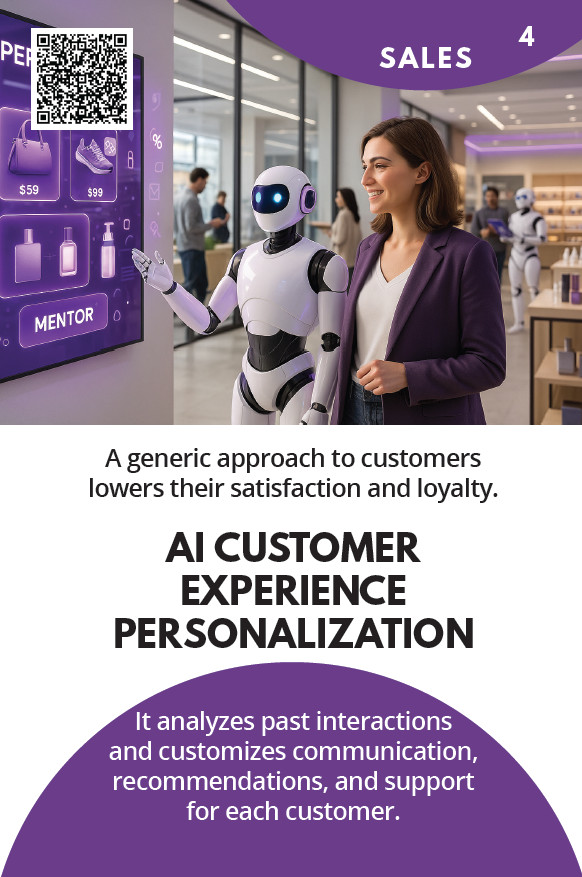
What challenge or problem does this AI solution solve?
Generic communication, the same offers for everyone, and delays in delivering relevant information reduce customer engagement, increase cart abandonment, and weaken loyalty. Teams often do not have a unified view of the customer across communication channels (web, email, social media, support), so they fail to recognize the right moment and the right message for action.
Why does AI solve this problem best?
Traditional marketing and CRM tools operate using static rules and do not learn from customer behavior in real time. AI uses behavior analysis, predictive models, and generative recommendations to identify micro-moments (purchase intent, abandonment risk, need for information) and automatically deliver the most relevant content in the right channel.
How does AI solve this challenge or problem?
The system collects data from all touchpoints, creates a unified customer profile, and for each user suggests the Next Best Action (for example, a product recommendation, educational content, or a support offer). It orchestrates messages in real time across channels (web, email, chatbot, social media), tests variants (A/B), and continuously learns from the results so that the next interaction is more successful.
What are the concrete benefits for the company?
By implementing this AI assistant, the company achieves:
- growth in NPS and customer satisfaction, a higher rate of repeat purchases, and lower churn,
- reduced cart abandonment and lower support costs through proactive interventions,
- a unified customer view and smart targeting that increases campaign conversions.
The sales team is freed from routine tasks and can focus on strategic customers.
Required data sets
To create this AI sales assistant, the following data sets are required:
- CRM: interaction history, segment, complaint statuses, satisfaction.
- ERP / e-commerce: order history, purchase frequency, stock levels, prices.
- Web & app: click paths, time on page, abandoned carts, events.
- Support channels and social media: inquiry topics, sentiment/tone, contact frequency.
- (Optional): campaigns/UTM parameters, open/click rate, channel preferences.
The data is used to train the AI model to recognize customer intent and automatically suggest optimal sales actions.
Elements for ROI calculation – Investment Profitability
CAPEX (investment):
- development and integration of the AI personalization model (profiling, recommendations, NBA),
- integration with CRM/ESP/e-commerce tools and the DWH/CDP layer,
- licenses/API and initial team training.
OPEX (costs):
- cloud and model maintenance, retraining, and performance monitoring,
- subscriptions for tools (CDP, orchestration, analytics), A/B testing,
- recommendation quality control, security, and compliance (privacy, consent).
KPI (success indicators):
- Increase in CTR of personalized recommendations (%).
- Accuracy of product/service recommendations (Recommendation Accuracy – F1-score).
- Increase in customer engagement (engagement rate, session duration).
- Reduction in bounce rate (%) on recommended pages / channels.
- Increase in conversions from personalized interactions (%) — attribution model.
Average ROI for this AI solution
- Return on investment: 50% – 140%
- Time to ROI: 4 – 10 months
- Best for: e-commerce, telecom, online platforms, SaaS products, banking, insurance, media companies, streaming platforms, tourism services, gaming industry
How do you choose and implement the right AI tools?
The first step toward successful implementation of AI solutions tailored to your business
2-day training for preparing the implementation of business AI solutions
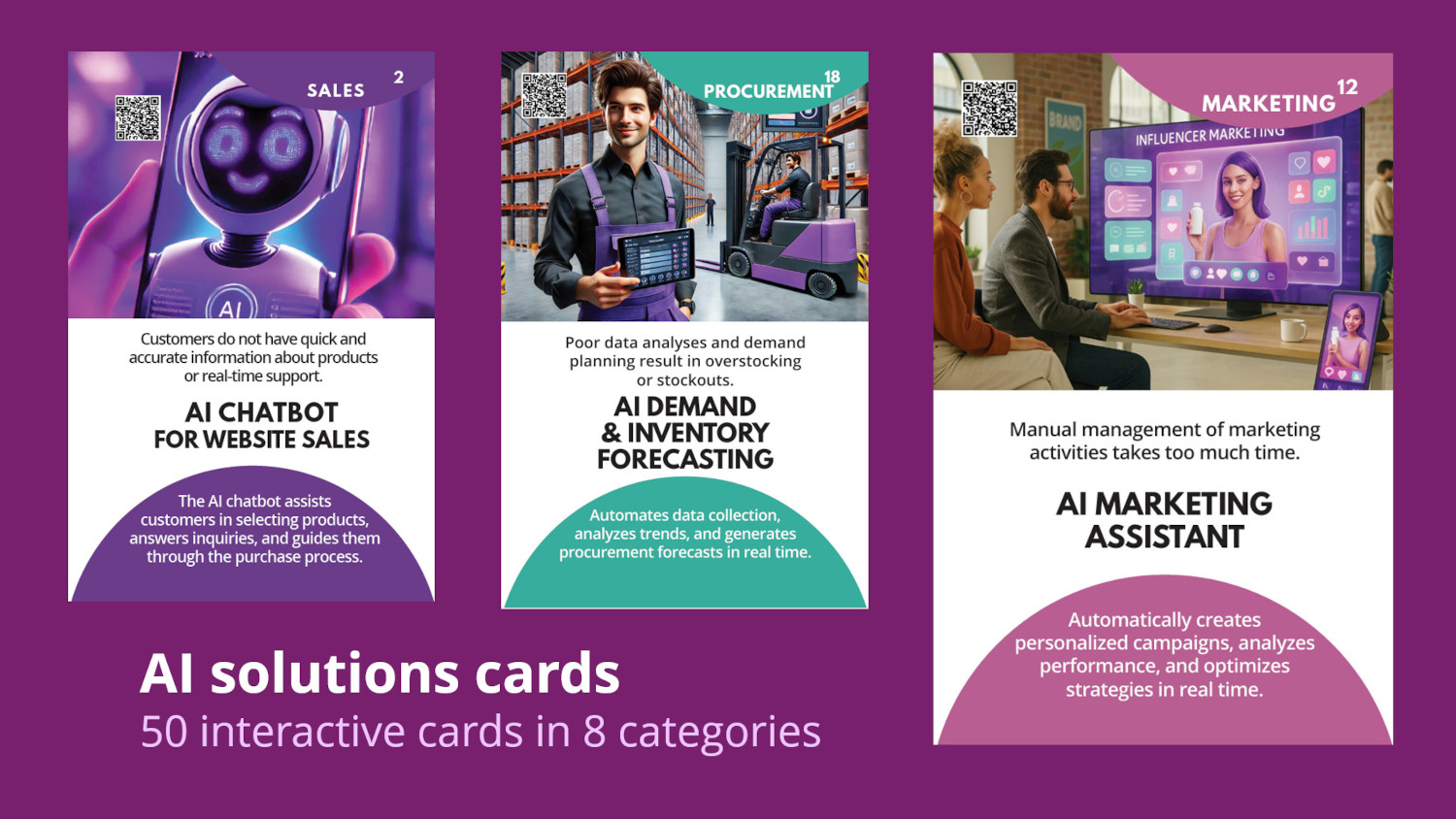
Start a successful Digital AI Transformation in our practical consulting workshop, using interactive visual AI cards (50 cards) that simply and intuitively connect your business challenges and operational problems with the appropriate AI solutions.
Visual interactive cards with business AI solutions
What do we do in our interactive workshop?
- AI solutions on our cards are not generic tools, but business solutions developed specifically for each company based on data and concrete needs.
- They are trained on your internal data and adapted to specific business processes — sales, procurement, production, or customer support.
- Unlike general online AI tools such as ChatGPT, Claude, or Gemini, these solutions provide full control over data within the company.
See how this workshop helps you make the best possible business decisions?
From the interactive workshop in Belgrade
Implement this AI solution
Together with leading AI companies in Serbia, we actively cooperate on the implementation of AI tool projects (business artificial intelligence solutions presented on our visual cards).
We will help you choose the AI solution and provider that best match your needs.