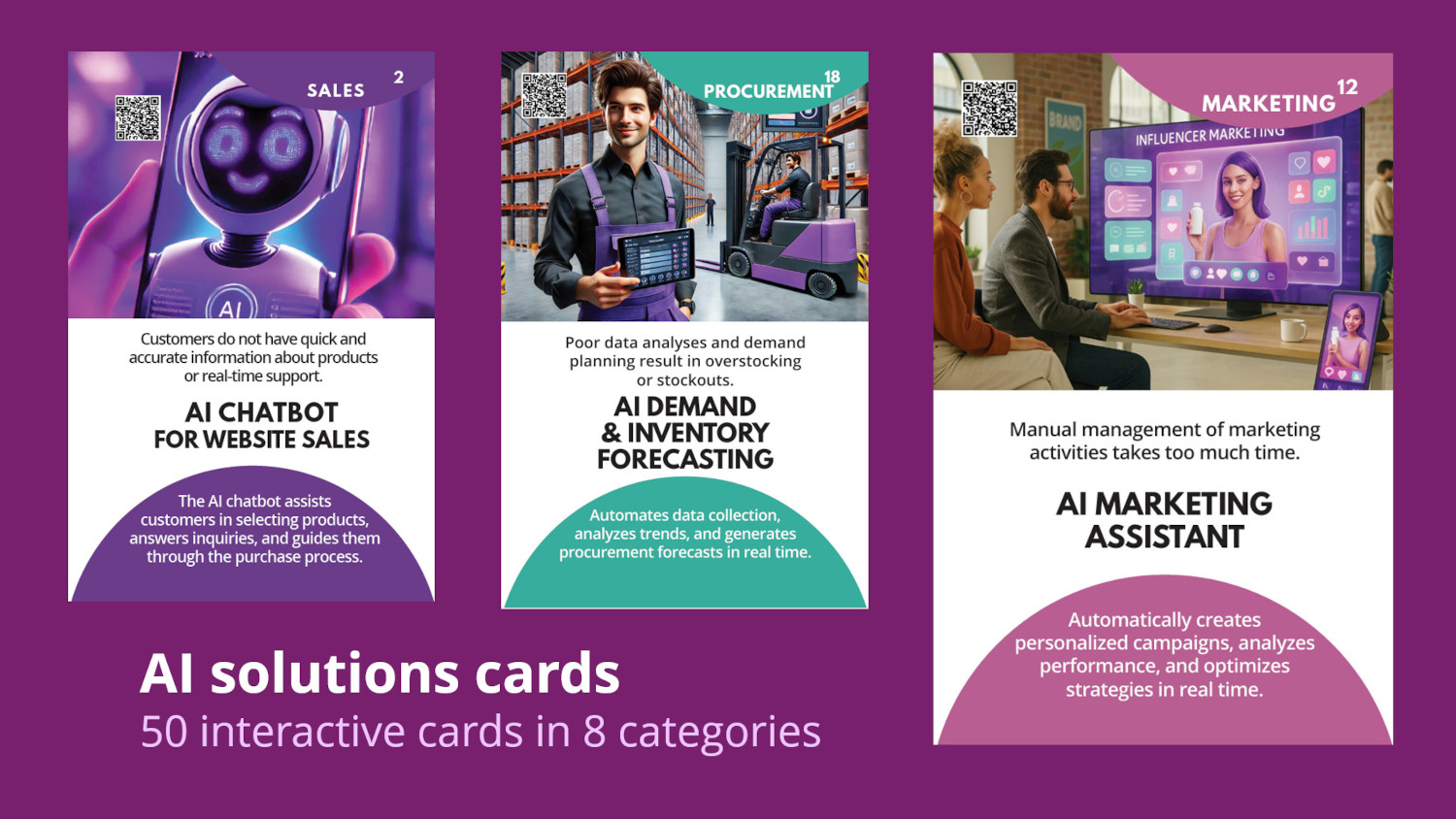
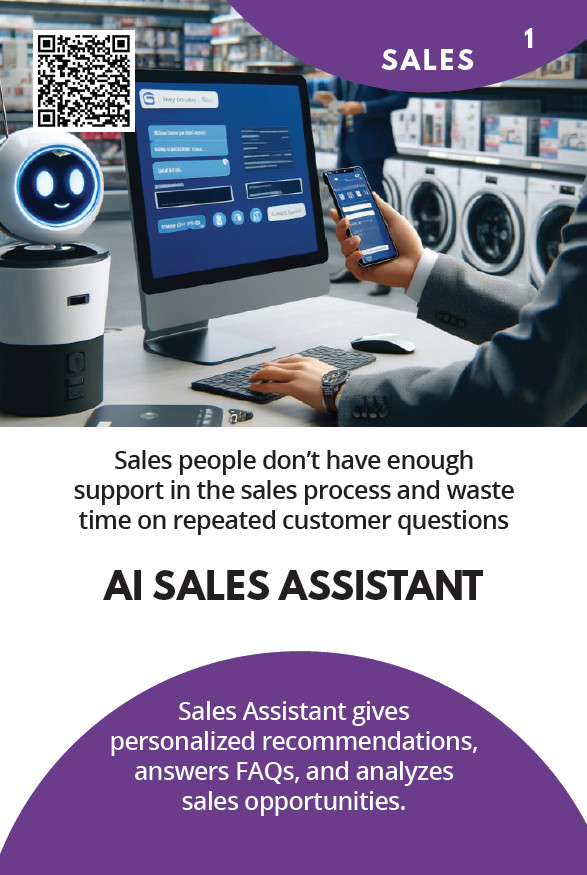
1. AI Sales Assistant
What challenge or problem does this AI solution solve?
Sales teams often spend too much time repeating the same tasks — responding to customer inquiries, creating offers, and entering data into the CRM. A lack of a personalized approach and slow response times lead to lost sales opportunities, lower conversion rates, and salespeople being overloaded with routine activities. Companies lose potential customers at the most important moment — when a client shows interest but does not receive fast and relevant information.
Why does AI solve this problem best?
Traditional CRM tools and automated systems cannot learn dynamically or adapt to customer behavior. Their rules are static and do not respond to real-time changes. The AI Sales Assistant uses predictive analytics, natural language processing (NLP), and the RAG model (Retrieval-Augmented Generation) to understand the context of each sales interaction and suggest the next best step for the salesperson. It learns from the history of interactions, recognizes patterns in customer behavior, and personalizes the approach in a way that increases the likelihood of conversion — something impossible to achieve with traditional software.
How does AI solve this challenge or problem?
The AI Sales Assistant automates and improves the entire sales process — from identifying potential clients to closing the deal.
- automatically identifies and scores leads (lead scoring),
- creates personalized offers and suggests additional products (cross-sell and up-sell),
- synchronizes appointments and meetings with the calendars of the sales team,
- records communication with clients and tracks the progress of each sales opportunity,
- analyzes historical data and predicts sales results.
In practice, during a meeting, a salesperson can use a voice query to instantly get information about the client, purchase history, and inventory status, which increases the relevance of the conversation and speeds up decision-making.
What are the concrete benefits for the company?
By implementing an AI assistant, the company achieves:
- 30–50% faster response time to customers,
- 20–35% higher conversion rate,
- up to 40% lower cost per sales opportunity.
The sales team is freed from routine tasks and can focus on strategic customers and high-quality relationships, while managers receive accurate and immediate real-time data on sales performance.
Required data sets
To build an AI Sales Assistant, the following data sets are required:
- CRM system: history of customer interactions (lead status, response time, offer outcome, sales value, conversions).
- ERP system: prices, product availability, delivery deadlines.
- Marketing data: lead sources, campaign performance, landing pages.
- Customer support (if available): frequent customer inquiries and complaints.
The data is used to train the AI model to recognize customer intent and automatically suggest the optimal next sales steps.
Elements for ROI calculation
CAPEX (investment):
- development and integration of the AI assistant (e.g. €12,000),
- licenses and API access (e.g. €3,000),
- employee training (e.g. €2,000).
OPEX (annual costs):
- maintenance and cloud costs (e.g. €500/month),
- performance monitoring and model updates.
KPI (success indicators):
- Increase in the lead → customer conversion rate (%) compared to the Q1 (1 quarter) baseline.
- Reduction in the time needed to prepare meetings and offers (min/hour), measured through CRM time logs.
- Increase in the number of qualified leads per salesperson (QML – Qualified Marketing Leads).
- Reduction in the number of lost opportunities due to delayed follow-up (%).
- Improvement in the accuracy of recommended next best actions (Next Best Action Accuracy, %).
Average ROI for this AI solution
- Return on investment: 50% – 150%
- Time to ROI: 4 – 10 months
- Best for: B2B sales, manufacturing, distribution, telecom, finance, insurance, SaaS, logistics, pharmaceuticals, industrial equipment, technical sales, automotive sector
.
How do you choose and implement the right AI tools?
2-day training for preparing the implementation of business AI solutions