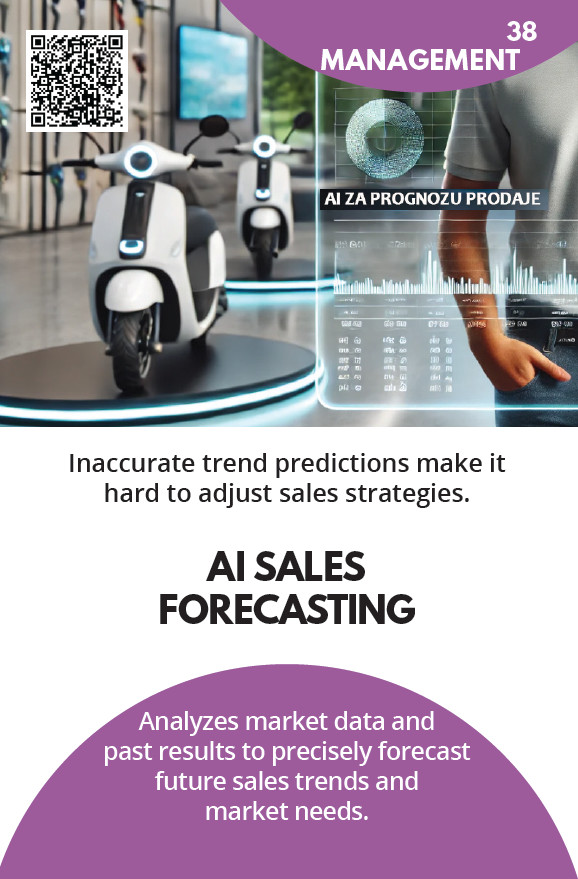
38. AI Sales Forecasting
What challenge or problem does this AI solution solve?
Companies often plan sales based on rough estimates, outdated reports, or individual experience rather than on reliable predictive models. Because of this, management reacts too late to changes in demand, misses market opportunities, plans production and procurement inefficiently, and sets unrealistic targets for teams. Poor sales forecasting directly affects revenue, cash flow, inventory, and business planning.
Why does AI solve this problem best?
Traditional forecasting methods usually rely on simple historical averages or manual assumptions. AI can analyze complex patterns in sales history, seasonality, campaigns, pricing, customer behavior, market changes, and operational constraints. It recognizes hidden relationships between factors, predicts future demand more precisely, and continuously improves as new data arrives. Unlike public AI services, this system is trained on internal company data, which ensures security, relevance, and direct usefulness for real sales planning.
How does AI solve this challenge or problem?
The AI system analyzes historical sales, product trends, customer segments, seasonality, campaigns, prices, pipeline movements, and external market signals. It forecasts future sales by product, channel, region, customer segment, or time period, identifies deviations from plan, and alerts management to possible changes in demand. The system can generate dashboards, scenario simulations, and recommendations that support planning of sales, procurement, inventory, staffing, and finances.
What are the concrete benefits for the company?
By implementing this AI assistant, the company achieves:
- More accurate sales planning and revenue forecasting.
- Faster reaction to changes in market demand and customer behavior.
- Better coordination between sales, procurement, production, and finance.
- Reduced planning errors and fewer surprises in execution.
- Better target setting and stronger support for management decisions.
The company’s management and sales teams work better, faster, easier, and more efficiently.
Required data sets
To create this AI sales assistant, the following data sets are required:
- Sales: historical sales, product categories, quantities, prices, channels, regions, and sales targets.
- CRM: customer segments, pipeline stages, opportunity history, conversion data, and customer behavior.
- Marketing: campaigns, promotions, seasonality effects, and lead-generation activity.
- Finance / operations: revenue plans, budgets, stock levels, procurement constraints, and margin data.
- (Optional): external market signals, macroeconomic indicators, competitor pricing, and weather or seasonal drivers.
The data is used to train the AI model so it can best adapt to your business.
Elements for ROI calculation – Investment Profitability
CAPEX (investment):
- Development of the AI model for sales forecasting and scenario analysis.
- Integration with CRM, ERP, BI, sales, and finance systems.
- Preparation, cleansing, and structuring of historical forecasting data.
OPEX (costs):
- Cloud and API costs for continuous forecasting calculations.
- Model maintenance and retraining with new sales and market data.
- Updating business rules, scenario assumptions, and forecast parameters.
KPI (success indicators):
- Improvement in forecast accuracy by product / channel / region (Forecast Accuracy %).
- Reduction in forecast error compared with baseline planning models.
- Reduction in time needed to prepare sales forecasts and planning reports.
- Improvement in alignment between sales forecast and operational execution.
- Increase in management response speed to forecast deviations.
Average ROI for this AI solution
- Return on investment: 60% – 150%
- Time to ROI: 3 – 9 months
- Best for: sales teams, management, retail, wholesale, manufacturing, distribution, telecom, SaaS, FMCG, and businesses with variable demand
How do you choose and implement the right AI tools?
The first step toward successful implementation of AI solutions tailored to your business
2-day training for preparing the implementation of business AI solutions
Start a successful Digital AI Transformation in our practical consulting workshop, using interactive visual AI cards (50 cards) that simply and intuitively connect your business challenges and operational problems with the appropriate AI solutions.
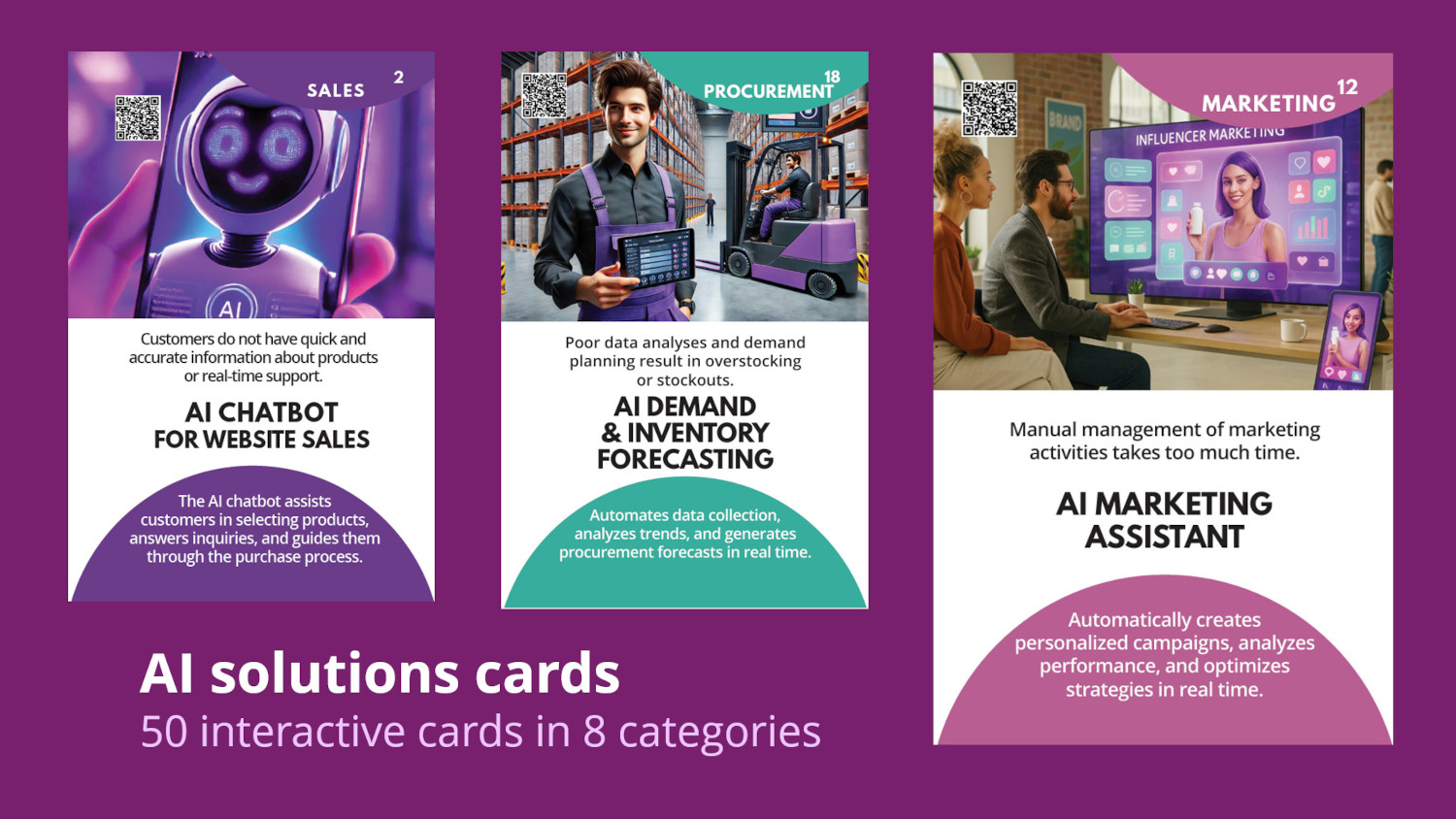
Visual interactive cards with business AI solutions
What do we do in our interactive workshop?
- AI solutions on our cards are not generic tools, but business solutions developed specifically for each company based on data and concrete needs.
- They are trained on your internal data and adapted to specific business processes — sales, procurement, production, or customer support.
- Unlike general online AI tools such as ChatGPT, Claude, or Gemini, these solutions provide full control over data within the company.
See how this workshop helps you make the best possible business decisions?
From the interactive workshop in Belgrade
Implement this AI solution
Together with leading AI companies in Serbia, we actively cooperate on the implementation of AI tool projects (business artificial intelligence solutions presented on our visual cards).
We will help you choose the AI solution and provider that best match your needs.