36. AI Predictive Analytics
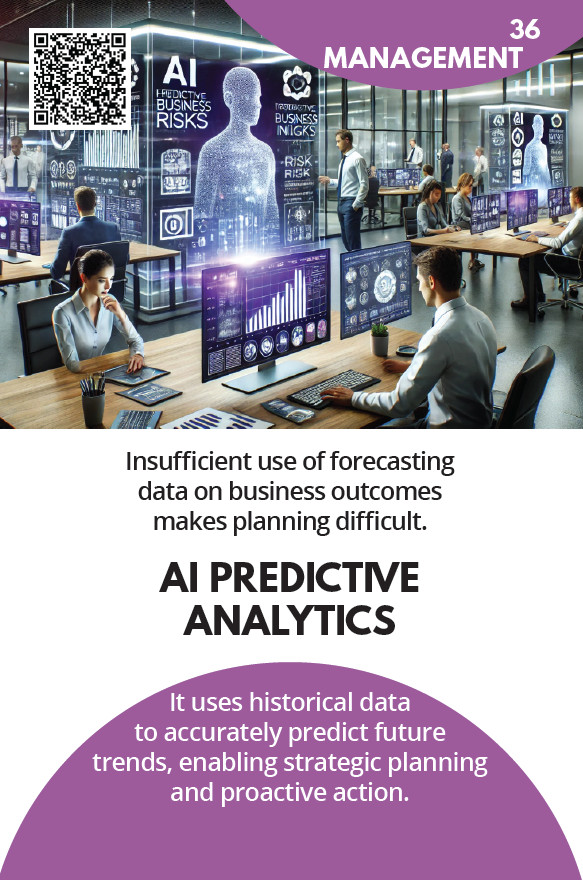
What challenge or problem does this AI solution solve?
Companies collect huge amounts of data every day, but most organizations use only basic reports, without deeper trend analysis or prediction of future events. Decisions are often made based on history or intuition, which leads to slow reactions, inefficient planning, and missed opportunities. Without advanced insights, it is difficult to predict demand, risks, defects, financial results, or customer behavior.
Why does AI solve this problem best?
Traditional BI tools show what happened, but they do not explain why it happened or what will happen next. AI models analyze historical and real-time data, recognize patterns, uncover hidden relationships between factors, and predict future trends with high accuracy. Unlike public AI services, an AI predictive model is custom-built and trained exclusively on the company’s internal data, which ensures security, accuracy, and relevance for specific processes.
How does AI solve this challenge or problem?
AI predictive analytics uses machine learning models to forecast key events: demand, sales results, failures, performance deviations, risks, employee turnover, credit risks, or customer behavior. The system analyzes large datasets, generates predictive scores, visualizes scenarios, and recommends actions that optimize future decisions. The model adapts in real time and becomes increasingly accurate as it receives new data.
What are the concrete benefits for the company?
By implementing this AI assistant, the company achieves:
- Better planning of production, procurement, sales, and finances.
- Faster reaction to changes in the market and operations.
- Identification of risks before they escalate.
- Cost optimization and revenue increase.
- Decision-making based on data, not intuition.
The company’s management teams work better, faster, easier, and more efficiently.
Required data sets
To create this AI sales assistant, the following data sets are required:
- Sales: sales history, channels, seasonality, prices, campaigns.
- Production: process parameters, performance, failures, downtime.
- Procurement: inventory, lead time, demand, procurement plans.
- Finance: revenues, expenses, margins, costs.
- CRM: customer behavior, inquiries, profiles, pipeline.
- (Optional: market data, macroeconomic indicators, competitor trends.)
The data is used to train the AI model so it can best adapt to your business.
Elements for ROI calculation – Investment Profitability
CAPEX (investment):
- Development of predictive AI models by business area (sales, procurement, HR, etc.).
- Integration with internal systems (ERP, CRM, MES, BI).
- Preparation and cleansing of historical datasets.
OPEX (costs):
- Cloud and API costs for continuous processing and retraining of models.
- Model maintenance and data enrichment.
- Updating business rules and prediction scenarios.
KPI (success indicators):
- Model accuracy in predicting key business metrics (Forecast MAPE/RMSE).
- Time needed to prepare analytical reports (Insight Generation Time).
- % of correctly identified trends and anomalies (Trend Detection Accuracy).
- Reduction in manual analysis (%).
- Model stability over time (Model Drift Index).
Average ROI for this AI solution
- Return on investment: 60% – 150%
- Time to ROI: 3 – 9 months
- Best for: finance, sales, procurement, risk management, marketing
How do you choose and implement the right AI tools?
The first step toward successful implementation of AI solutions tailored to your business
2-day training for preparing the implementation of business AI solutions
Start a successful Digital AI Transformation in our practical consulting workshop, using interactive visual AI cards (50 cards) that simply and intuitively connect your business challenges and operational problems with the appropriate AI solutions.
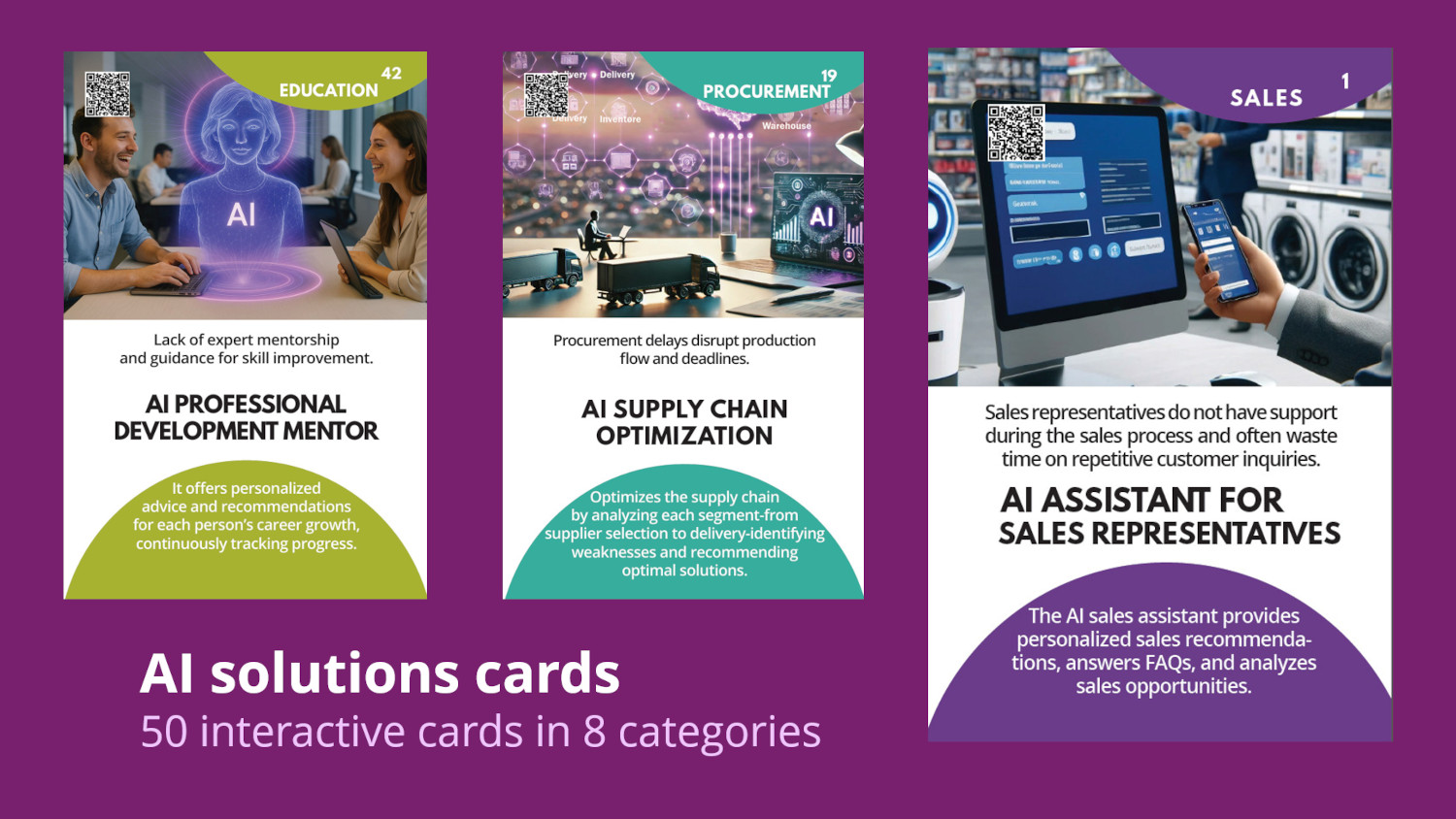
Visual interactive cards with business AI solutions
What do we do in our interactive workshop?
- AI solutions on our cards are not generic tools, but business solutions developed specifically for each company based on data and concrete needs.
- They are trained on your internal data and adapted to specific business processes — sales, procurement, production, or customer support.
- Unlike general online AI tools such as ChatGPT, Claude, or Gemini, these solutions provide full control over data within the company.
See how this workshop helps you make the best possible business decisions?
From the interactive workshop in Belgrade
Implement this AI solution
Together with leading AI companies in Serbia, we actively cooperate on the implementation of AI tool projects (business artificial intelligence solutions presented on our visual cards).
We will help you choose the AI solution and provider that best match your needs.