29. AI Robotic Automation
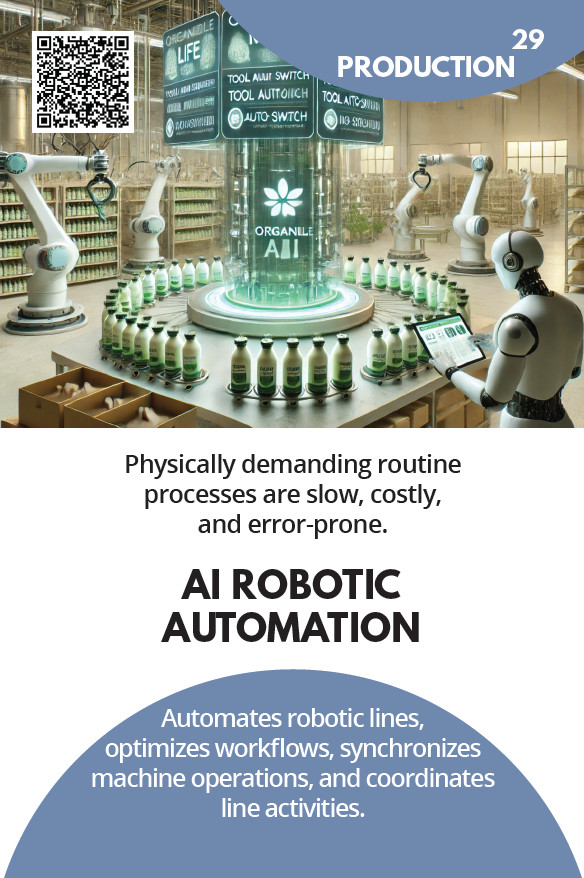
What challenge or problem does this AI solution solve?
Production and operational teams often spend too much time on repetitive, physically demanding, and precision-sensitive tasks. Manual execution can lead to slower throughput, inconsistent quality, more errors, safety risks, and inefficient use of human resources. As production volumes grow, it becomes harder to maintain speed, precision, and stable output with manual work alone.
Why does AI solve this problem best?
Traditional automation follows fixed rules and predefined movements, but it does not adapt well to changing conditions, variable inputs, or more complex situations. AI robotic automation combines robotics, computer vision, sensor data, and machine learning to make robotic systems more flexible, precise, and responsive. Unlike public AI services, this system is trained on internal production data and operational conditions, which ensures security, relevance, and direct application in the company’s real working environment.
How does AI solve this challenge or problem?
The AI system analyzes work instructions, sensor data, visual inputs, and machine conditions to guide robotic actions in real time. It helps robots perform repetitive tasks such as handling, sorting, assembly, packaging, inspection, and movement of materials more accurately and consistently. The system can recognize objects, adapt movements, optimize task sequences, and improve performance based on data from previous cycles. It also generates operational insights and alerts for supervisors and engineers.
What are the concrete benefits for the company?
By implementing this AI assistant, the company achieves:
- Higher speed and consistency in repetitive operational tasks.
- Reduction in manual errors and variability in execution.
- Better use of human resources for higher-value work.
- Improved workplace safety in repetitive or risky operations.
- Higher throughput and more stable production performance.
Employees manage production better, more easily, faster, and more efficiently.
Required data sets
To create this AI sales assistant, the following data sets are required:
- Robotic operations: task sequences, movement paths, execution logs, cycle times, and error records.
- Computer vision / sensors: camera data, object detection, position recognition, distance, force, and motion signals.
- Production systems: MES / SCADA / PLC signals, machine states, line conditions, and process parameters.
- Quality / maintenance: defect history, stoppages, calibration data, and maintenance interventions.
- (Optional): digital twins, simulation data, worker interaction logs, and external environment conditions.
The data is used to train the AI model so it can best adapt to your business.
Elements for ROI calculation – Investment Profitability
CAPEX (investment):
- Development of the AI model for robotic task control and adaptation.
- Integration with robotic systems, sensors, vision systems, and production platforms.
- Setup of robotic logic, workcell rules, and operational dashboards.
OPEX (costs):
- Model maintenance and retraining with new operational and robotic data.
- Cloud processing and API costs for vision and real-time control analytics.
- Updating robotic routines, safety rules, and process parameters.
KPI (success indicators):
- Increase in robotic task throughput and cycle efficiency.
- Reduction in operational errors and rework caused by repetitive tasks.
- Improvement in task consistency and execution precision.
- Reduction in manual intervention and stoppage events.
- Improvement in safety and productivity in automated workcells.
Average ROI for this AI solution
- Return on investment: 80% – 200%
- Time to ROI: 6 – 14 months
- Best for: manufacturing, automotive, electronics, food industry, logistics, packaging, pharmaceuticals, and repetitive industrial operations
How do you choose and implement the right AI tools?
The first step toward successful implementation of AI solutions tailored to your business
2-day training for preparing the implementation of business AI solutions
Start a successful Digital AI Transformation in our practical consulting workshop, using interactive visual AI cards (50 cards) that simply and intuitively connect your business challenges and operational problems with the appropriate AI solutions.
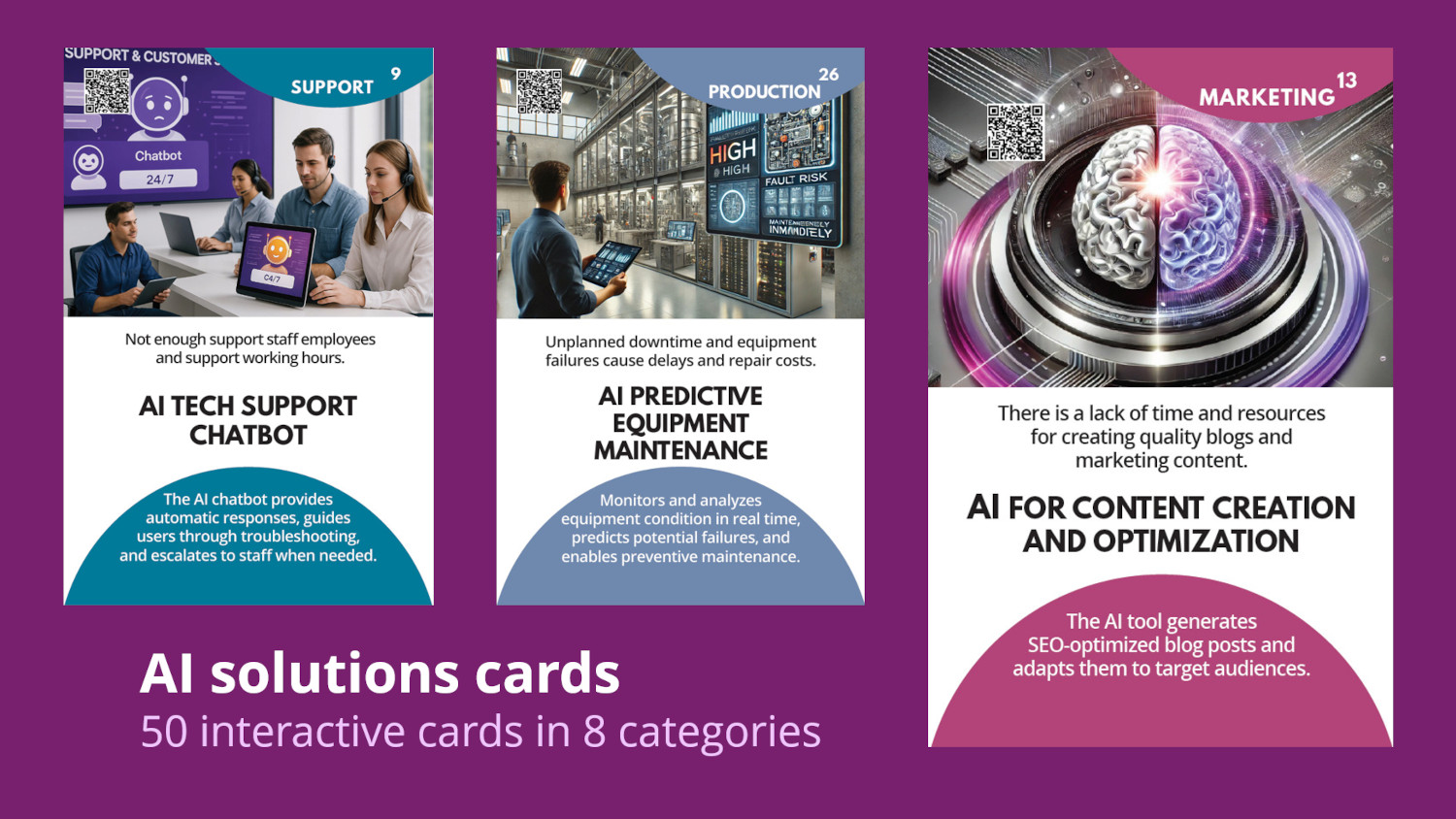
Visual interactive cards with business AI solutions
What do we do in our interactive workshop?
- AI solutions on our cards are not generic tools, but business solutions developed specifically for each company based on data and concrete needs.
- They are trained on your internal data and adapted to specific business processes — sales, procurement, production, or customer support.
- Unlike general online AI tools such as ChatGPT, Claude, or Gemini, these solutions provide full control over data within the company.
See how this workshop helps you make the best possible business decisions?
From the interactive workshop in Belgrade
Implement this AI solution
Together with leading AI companies in Serbia, we actively cooperate on the implementation of AI tool projects (business artificial intelligence solutions presented on our visual cards).
We will help you choose the AI solution and provider that best match your needs.