27. AI Product Quality Management
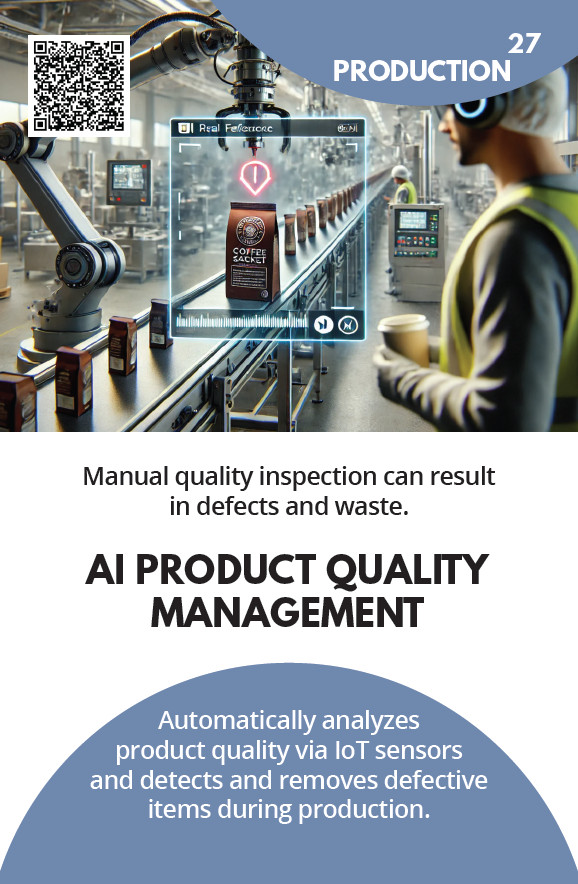
What challenge or problem does this AI solution solve?
Product quality control traditionally relies on manual inspections, visual checks, physical testing, and worker experience. This process is slow, subjective, and prone to errors, especially in large production series. Quality failures lead to complaints, product returns, downtime, higher costs, and damage to brand reputation.
Why does AI solve this problem best?
Traditional quality-control methods cannot identify microscopic irregularities or analyze data in real time. AI uses advanced computer vision, IoT sensors, and statistical analytics to automatically detect defects, anomalies, and deviations in the production process. Unlike public AI services, AI systems for quality control are trained exclusively on internal industrial data, which ensures maximum accuracy, security, and compliance with company standards.
How does AI solve this challenge or problem?
The AI model analyzes product images, measurements, sensor data, and process parameters in order to detect errors in dimensions, color, texture, assembly, packaging, or component integrity. The system automatically classifies defects, collects defect statistics, proposes corrective actions, and alerts operators in real time. It can be integrated with cameras, IoT devices, SCADA/MES systems, and robots (SCADA = Supervisory Control and Data Acquisition, WMS = Warehouse Management System).
What are the concrete benefits for the company?
By implementing this AI assistant, the company achieves:
- Much more precise and faster defect detection.
- Reduction in complaints and Cost of Poor Quality.
- Greater product consistency and standardization.
- Faster decision-making on corrective and preventive actions.
- Improved reputation and customer satisfaction.
Employees manage production better, more easily, faster, and more efficiently.
Required data sets
To create this AI sales assistant, the following data sets are required:
- Visual data: images, video recordings, camera feeds from the line.
- IoT sensors: temperature, pressure, vibrations, speed, humidity.
- Process parameters: standard operating modes, tolerances, limits.
- Quality history: complaints, defect categorization, QMS records.
- Production: OEE, batch records, control points, tests.
The data is used to train the AI model so it can best adapt to your business.
Elements for ROI calculation – Investment Profitability
CAPEX (investment):
- Development of the AI system for computer vision and quality analysis.
- Integration with cameras, IoT sensors, SCADA/MES, and QMS.
- Establishing tolerance parameters and quality rules.
OPEX (costs):
- Cloud and API costs for processing visual and process data.
- Model maintenance and periodic retraining.
- Updating defect categories and quality standards.
KPI (success indicators):
- Accuracy of equipment failure prediction (Failure Prediction Accuracy – F1-score).
- Reduction in unplanned downtime (Unplanned Downtime %, hours).
- Reduction in maintenance costs per machine (Maintenance Cost Reduction %).
- Extension of equipment working life (Asset Life Extension %).
- Response time from alarm to intervention (Time-to-Intervention, min).
Average ROI for this AI solution
- Return on investment: 60% – 160%
- Time to ROI: 4 – 10 months
- Best for: pharmaceuticals, automotive industry, electronics, food industry, metal-processing industry
How do you choose and implement the right AI tools?
The first step toward successful implementation of AI solutions tailored to your business
2-day training for preparing the implementation of business AI solutions
Start a successful Digital AI Transformation in our practical consulting workshop, using interactive visual AI cards (50 cards) that simply and intuitively connect your business challenges and operational problems with the appropriate AI solutions.
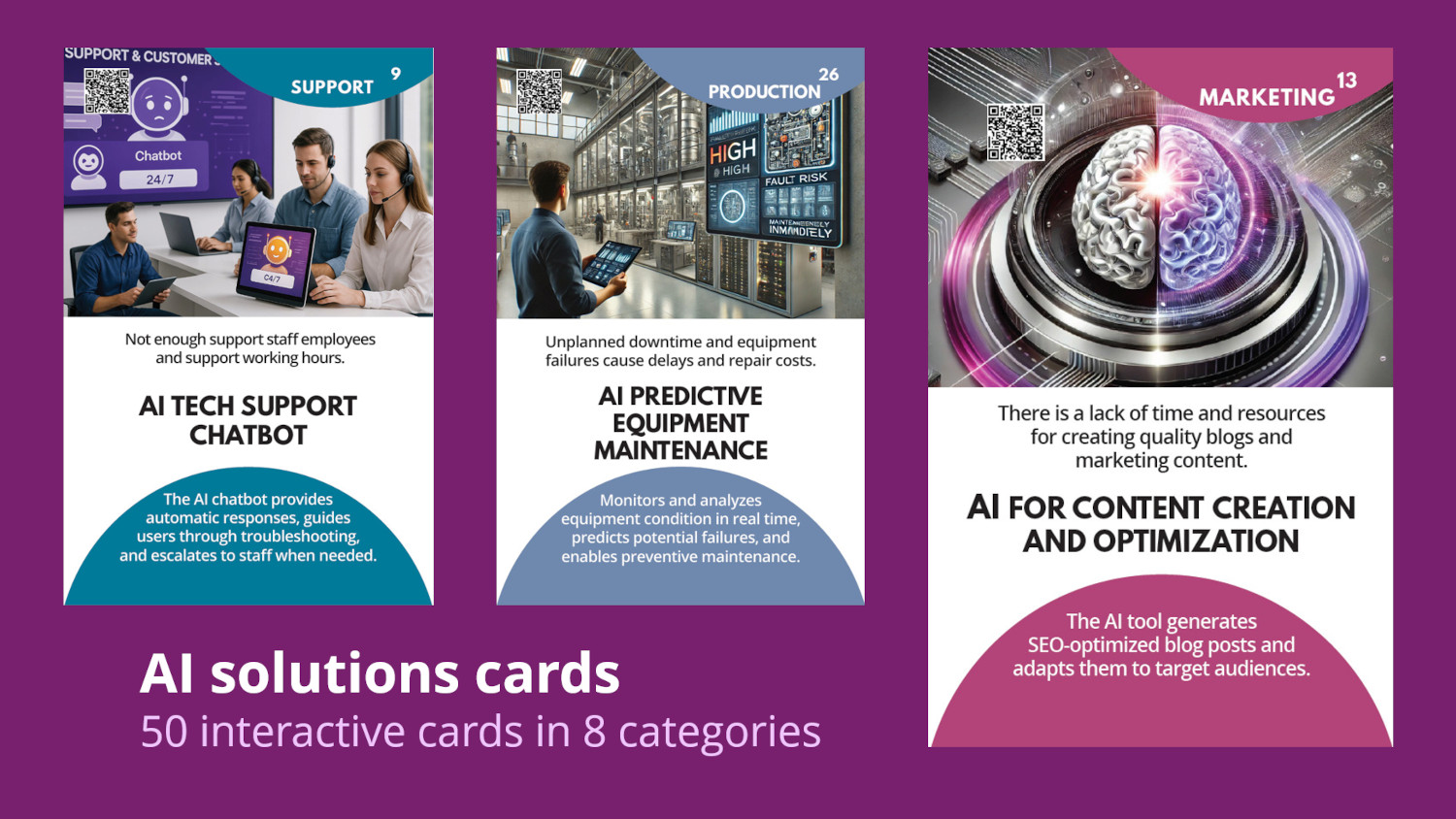
Visual interactive cards with business AI solutions
What do we do in our interactive workshop?
- AI solutions on our cards are not generic tools, but business solutions developed specifically for each company based on data and concrete needs.
- They are trained on your internal data and adapted to specific business processes — sales, procurement, production, or customer support.
- Unlike general online AI tools such as ChatGPT, Claude, or Gemini, these solutions provide full control over data within the company.
See how this workshop helps you make the best possible business decisions?
From the interactive workshop in Belgrade
Implement this AI solution
Together with leading AI companies in Serbia, we actively cooperate on the implementation of AI tool projects (business artificial intelligence solutions presented on our visual cards).
We will help you choose the AI solution and provider that best match your needs.