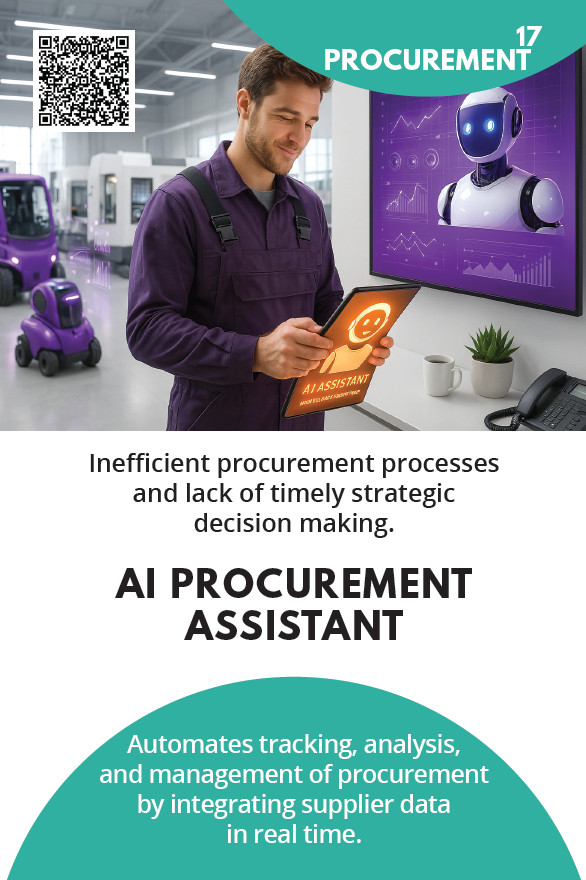
17. AI Procurement Assistant
What challenge or problem does this AI solution solve?
Procurement faces a large number of operational tasks every day — collecting offers, analyzing suppliers, comparing prices, checking deadlines, tracking delivery quality, managing documentation, and handling communication. Manual work slows down processes, increases the risk of mistakes, and leaves little time for strategic decision-making. Lack of automation leads to delays, higher costs, and a weaker negotiating position.
Why does AI solve this problem best?
Traditional procurement systems do not perform independent analyses, recognize risk patterns, or provide recommendations. The AI model automatically processes procurement data, analyzes supplier history, costs, deadlines, and delivery quality, and suggests the best decisions. Unlike public AI services, this system is custom-built and trained exclusively on internal company data, which guarantees security, accuracy, and full control over confidential information.
How does AI solve this challenge or problem?
The AI Procurement Assistant autonomously collects and compares offers, analyzes suppliers, assesses risks, suggests the most favorable options, warns about delays, and identifies anomalies in prices or quality. The system automatically generates RFI/RFQ documents, prepares analytical reports, tracks delivery history, and recommends suppliers that best match the company’s goals. It can integrate with ERP and automate the entire procurement flow.
What are the concrete benefits for the company?
By implementing this AI assistant, the company achieves:
- Faster and more precise supplier evaluation.
- Significant savings through optimization of prices and terms.
- Reduction of the risk of quality problems and delays.
- Less administrative work and fewer mistakes.
- A stronger negotiating position based on real data and analysis.
The company’s procurement team carries out procurement more accurately, easily, quickly, and efficiently.
Required data sets
To create this AI sales assistant, the following data sets are required:
- Procurement: supplier offers, prices, terms, delivery deadlines, delivery quality.
- ERP: order history, cost records, supplier master data.
- Quality: complaints, defective deliveries, compliance percentages.
- Finance: invoices, budget compliance, payment deadlines.
- (Optional: negotiation history, contracts, supplier ratings.)
The data is used to train the AI model so it can best adapt to your business.
Elements for ROI calculation – Investment Profitability
CAPEX (investment):
- Development of the AI model for supplier evaluation and risk prediction.
- Integration with ERP and procurement systems.
- Implementation of procurement rules and processes within the AI system.
OPEX (costs):
- Model maintenance and retraining on new data.
- Cloud and API costs for processing larger datasets.
- Updating supplier data, price lists, and processes.
KPI (success indicators):
- Reduction in average Procure-to-Pay time (P2P Cycle Time, in days).
- Accuracy of request and item classification (Procurement Intent Accuracy – F1-score).
- Reduction in manual errors in orders (% error reduction).
- Increase in supplier categorization accuracy (Supplier Category Accuracy %).
- Tender preparation time (Tender Prep Time, hours → minutes).
Average ROI for this AI solution
- Return on investment: 50% – 140%
- Time to ROI: 4 – 10 months
- Best for: manufacturing, logistics, construction, energy, food industry, pharmaceuticals, industrial equipment
How do you choose and implement the right AI tools?
The first step toward successful implementation of AI solutions tailored to your business
2-day training for preparing the implementation of business AI solutions
Start a successful Digital AI Transformation in our practical consulting workshop, using interactive visual AI cards (50 cards) that simply and intuitively connect your business challenges and operational problems with the appropriate AI solutions.
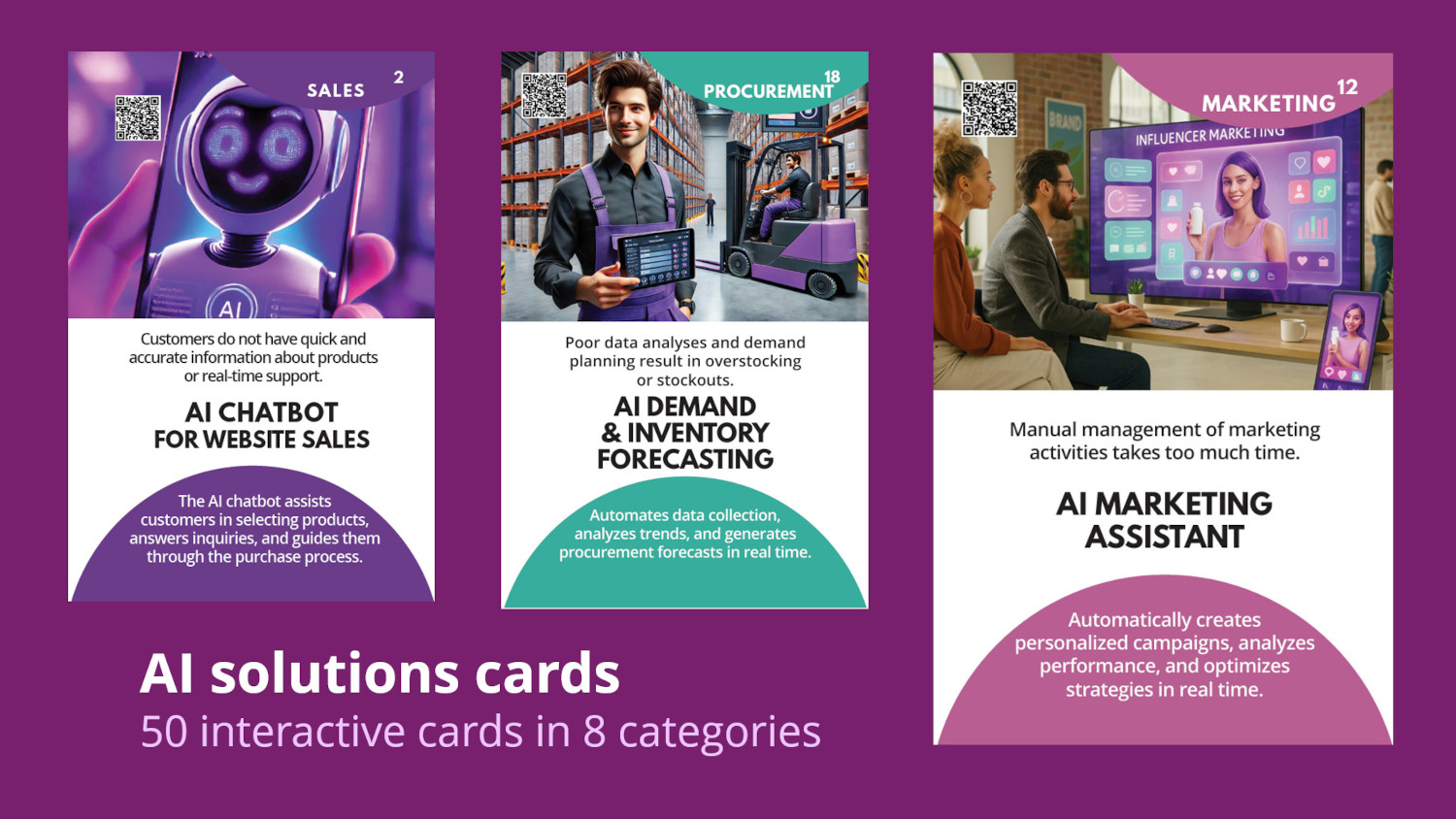
Visual interactive cards with business AI solutions
What do we do in our interactive workshop?
- AI solutions on our cards are not generic tools, but business solutions developed specifically for each company based on data and concrete needs.
- They are trained on your internal data and adapted to specific business processes — sales, procurement, production, or customer support.
- Unlike general online AI tools such as ChatGPT, Claude, or Gemini, these solutions provide full control over data within the company.
See how this workshop helps you make the best possible business decisions?

From the interactive workshop in Beograd
Implement this AI solution
Together with leading AI companies in Serbia, we actively cooperate on the implementation of AI tool projects (business artificial intelligence solutions presented on our visual cards).
We will help you choose the AI solution and provider that best match your needs.