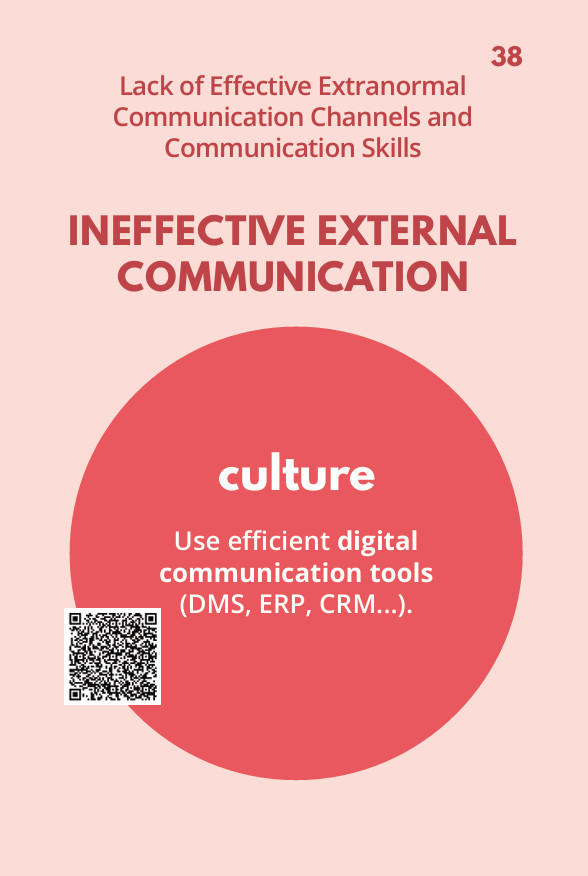
Ineffective External Communication – ORGANISATIONAL CULTURE – 38
When communication with customers, partners, or the wider public is unclear, inconsistent, or misaligned with reality, trust erodes and the organization’s reputation suffers—often long before anyone internally notices the problem.
Where you’ll notice this in everyday work
Ineffective external communication often becomes visible through confusion, mixed expectations, and repeated clarifications from people outside the organization. Internally, teams may not immediately feel the impact, but externally the signals are clear.
- Customers receive inconsistent messages from sales, marketing, and support.
- Promises don’t match delivery, leading to complaints or frustration.
- Brand messages change frequently without clear explanation.
- Partners are unsure who to contact or what to expect.
- Public communication feels generic and disconnected from reality.
- Negative feedback repeats around “lack of clarity” or “poor communication.”
Over time, external stakeholders stop relying on official communication and seek information informally—or disengage completely.
Why it happens
Poor external communication usually reflects internal misalignment. When teams are not aligned internally, their messages to the outside world inevitably become fragmented.
- No clear ownership: nobody is fully responsible for external messaging.
- Siloed communication: departments communicate independently.
- Overpromising: marketing or sales commits beyond operational capacity.
- Lack of feedback loops: external reactions are not analysed internally.
- Pressure to look perfect: reality is “polished” instead of explained honestly.
When communication is driven by assumptions instead of shared understanding, credibility quickly suffers.
How it affects results
Ineffective external communication directly affects trust, reputation, and long-term business relationships.
- loss of customer confidence and loyalty,
- increased complaints and rework,
- damaged brand credibility,
- missed partnership opportunities,
- higher pressure on frontline employees.
How to reduce and overcome it
Effective external communication starts internally. Clarity, honesty, and consistency are more powerful than polished but empty messages.
- Align internally first: ensure teams share the same facts and priorities.
- Define one voice: clarify who owns external communication.
- Set realistic expectations: communicate what is truly possible.
- Listen actively: collect and review external feedback regularly.
- Be transparent: explain changes, delays, or limitations openly.
Practical tools
1) External Message Alignment Check
Before publishing or sending key messages, review them with representatives from operations, sales, and support.
2) Promise–Delivery Review
Regularly compare what is promised externally with what is actually delivered, and adjust messaging accordingly.
3) Single Source of Truth
Maintain one shared document or page with up-to-date external messages, key facts, and approved wording.
4) Feedback Capture Loop
Collect customer and partner feedback systematically and review patterns monthly with relevant teams.
Recommended links
Improve Your Team Heath and Effectiveness
How can your team overcome hidden obstacles that slow it down?
Take our 3-day Organizational Health Improvement Workshop
- How can you identify specific problems and challenges in teamwork, cooperation, and internal communication among employees?
- How can you discover the root causes of these challenges and successfully solve them using our visual interactive “team effectiveness” cards?


By placing the visual cards on the Urgent–Important matrix, you can quickly and easily set priorities and create an action plan.

From an interactive workshop in Belgrade
Contact us to schedule a meeting
Tel: + 381 65 26 080 26
Email: poslovnaznanja@gmail.com