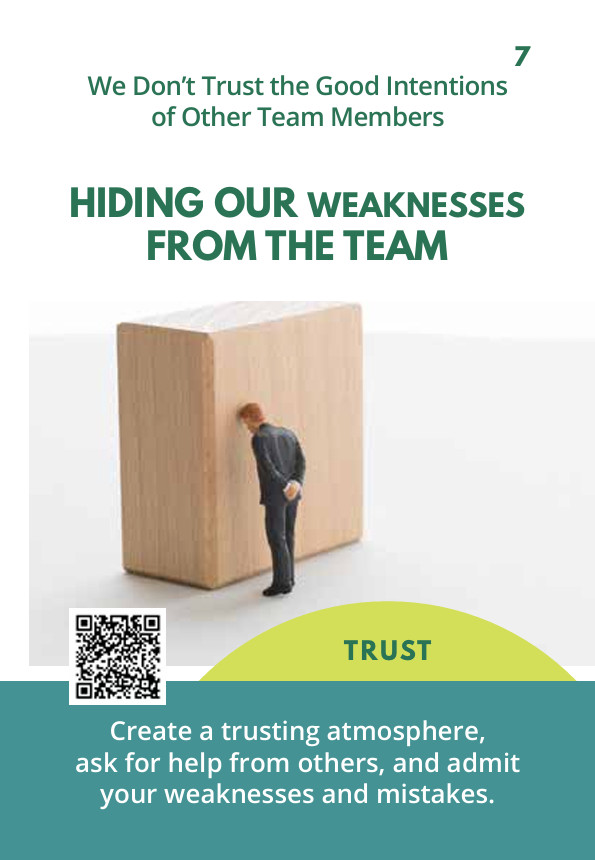
Hiding our Weaknesses from the Team – TRUST – 7
When people feel they must look “perfect,” the team loses honesty, learning, and real support.
Where you’ll notice this in a team
This problem is often “quiet,” but it shows up in very practical ways:- Meetings: people only share polished updates; risks and uncertainty are hidden until the last moment.
- When someone is overloaded: instead of asking for help, they say “I’m fine” and silently struggle—then deadlines slip.
- After mistakes: the team avoids talking about what happened; the same errors repeat because nobody wants to look incompetent.
- New colleagues: they hesitate to ask “basic questions,” so they guess—creating rework and misunderstandings.
- 1:1 conversations: people talk about symptoms (“I’m tired”) but not the real issue (“I’m not sure what’s expected” / “I don’t know how to do this”).
- Learning culture: training is attended, but real practice is avoided because “what if I fail in front of others?”
Why it happens
People hide weaknesses when the environment feels unsafe. The most common causes are:- Fear of being judged: “If they see I don’t know something, they’ll think I’m not good enough.”
- Past negative experiences: mistakes were punished, mocked, or brought up later in conflicts or performance reviews.
- Competitive culture: team members feel they must prove value all the time (especially in high-pressure or political environments).
- Unclear expectations: when people don’t know what “good” looks like, they protect themselves by showing only what seems safe.
- Leader behaviour: if leaders never admit uncertainty or mistakes, the team learns that vulnerability is dangerous.
How to reduce and overcome it
The goal is simple: make it normal to say “I don’t know yet,” “I need help,” and “I made a mistake”—without fear. That’s how teams become faster, not weaker.- Leaders go first: model vulnerability in a professional way (share uncertainty, lessons learned, and what support you need).
- Normalize questions: treat questions as quality control (“If one person is confused, others are too”).
- Make risks visible early: reward early warning, not “heroic last-minute rescue.”
- Separate mistakes from blame: talk about causes and improvements, not personalities.
- Create small, safe routines: short check-ins and structured formats help people open up without feeling exposed.
Practical communication tools
1) “Red–Yellow–Green” check-in (fast risk visibility)
At the start of a weekly meeting (2–3 minutes), each person says:- Green: on track, no help needed
- Yellow: some risk, I might need support
- Red: blocked / high risk, I need help now
2) “Ask for help” script (simple, non-embarrassing)
Many people don’t ask for help because they don’t know how to do it without feeling weak. Use this short structure:- Context: “I’m working on X and I’m stuck at Y.”
- What I tried: “I already tried A and B.”
- What I need: “Can you help me with (decision / input / example / 15 minutes to review)?”
- Deadline: “I need it by (time/date) so we stay on track.”
3) Learning review after mistakes (no-blame “What / So what / Now what”)
Instead of silence (or blame), run a 10–15 minute learning review:- What happened? (facts only)
- So what? (impact, risks, lessons)
- Now what? (one concrete improvement + owner + next step)
4) Psychological safety micro-moves (leader behaviours you can repeat)
- Thank the risk: “Thanks for raising this early.”
- Invite voice: “What are we not saying out loud?”
- Make uncertainty normal: “I’m not sure yet—let’s think together.”
- Protect people publicly: correct mocking, interruptions, sarcasm, or blame immediately.
5) “Two-minute clarity” (reduce hiding caused by confusion)
Often people hide weakness because they don’t understand expectations. Use this quick tool in tasks and meetings:- Goal: what does “done” look like?
- Owner: who decides / who delivers?
- Next step: what happens in the next 24–48 hours?
- Risk: what could block us—and when will we raise it?
Useful links
- Google re:Work – Team effectiveness (psychological safety)
- Harvard Business Review – Psychological safety collection
- Amy Edmondson – Psychological safety resources
- Atlassian Team Playbook – Health Monitor
- MindTools – Giving & receiving feedback
- Radical Candor – Practical approach to honest conversations
Improve Your Team Heath and Effectiveness
How can your team overcome hidden obstacles that slow it down?
Take our 3-day Organizational Health Improvement Workshop
- How can you identify specific problems and challenges in teamwork, cooperation, and internal communication among employees?
- How can you discover the root causes of these challenges and successfully solve them using our visual interactive “team effectiveness” cards?
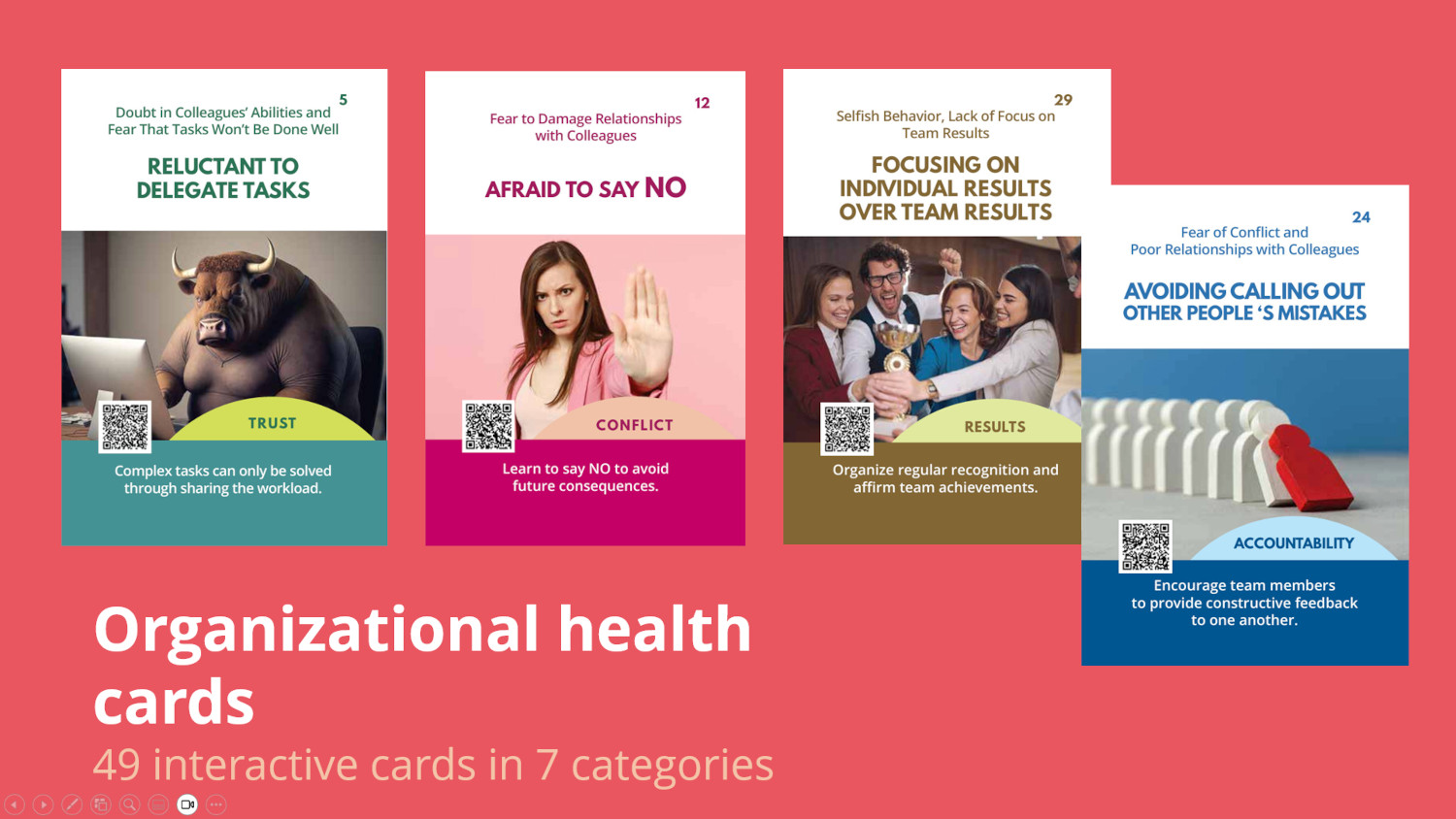
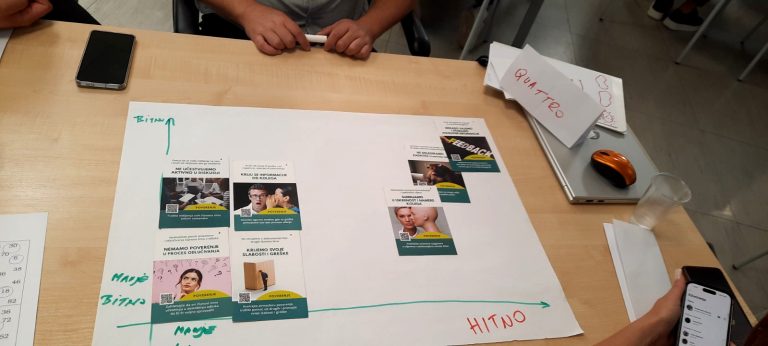
By placing the visual cards on the Urgent–Important matrix, you can quickly and easily set priorities and create an action plan.
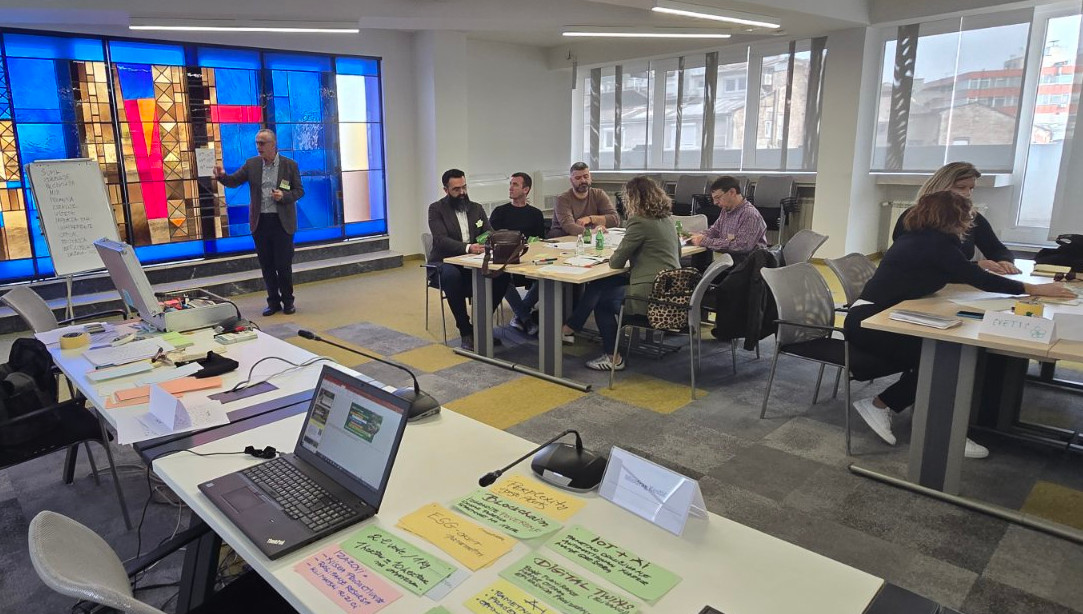
From an interactive workshop in Belgrade
Contact us to schedule a meeting
Tel: + 381 65 26 080 26
Email: poslovnaznanja@gmail.com