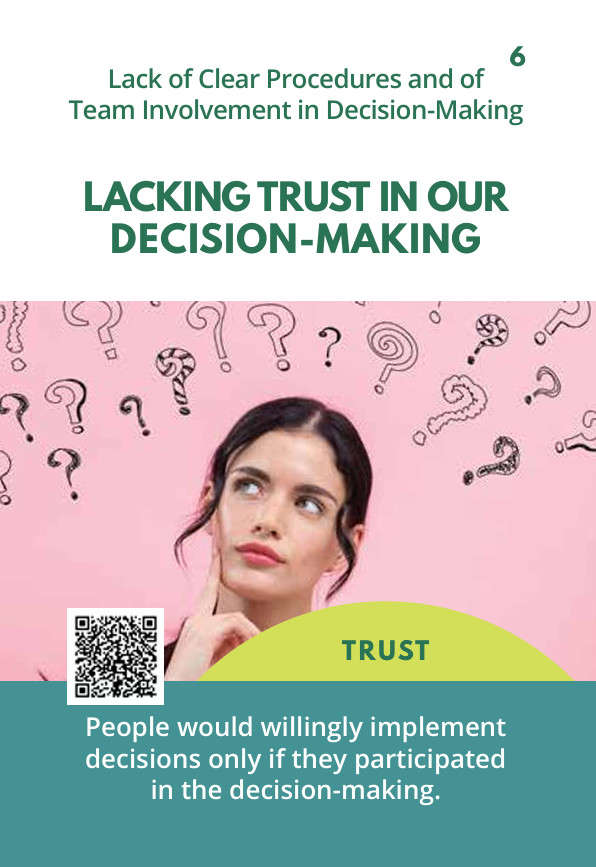
Lacking Trust in our Decision-Making – TRUST – 6
When teams don’t trust their own decisions, progress slows and confidence erodes.
Where you’ll notice this in a team
This issue becomes visible when teams hesitate, second-guess themselves, or constantly revisit decisions instead of moving forward with confidence.- In meetings: decisions are postponed or revisited repeatedly.
- After decisions: people quietly question whether the “right” choice was made.
- In execution: teams wait for confirmation before acting.
- In responsibility: no one fully owns the outcome.
- In pressure situations: stress increases because clarity is missing.
Why it happens
Lack of trust in decision-making usually develops over time and is closely linked to how decisions are made and communicated.- Unclear decision processes: people don’t know how or by whom decisions are made.
- Too many decision makers: responsibility is diluted.
- Fear of mistakes: past failures were punished instead of treated as learning.
- Lack of data or context: decisions feel subjective or arbitrary.
- Missing follow-through: decisions are made but not supported.
How it affects results
Teams that lack confidence in decision-making struggle to execute consistently and effectively.- slow execution and missed opportunities,
- constant re-alignment and rework,
- lower accountability,
- increased stress and frustration,
- reduced ownership and initiative.
How to reduce and overcome it
Trust in decision-making grows when the process is clear, consistent, and fair — even when decisions are difficult.- Clarify decision ownership: define who decides, who contributes, and who executes.
- Explain the reasoning: share the logic behind decisions.
- Encourage constructive disagreement: debate before deciding, align afterward.
- Accept imperfection: not all decisions can be perfect.
- Support decisions after they are made: avoid undermining them later.
Practical communication tools
These tools help teams make decisions visible, understandable, and trustworthy.- Decision clarity check: clearly state what has been decided and what has not.
- Roles in decisions: define who recommends, decides, and implements.
- Decision summaries: capture key decisions in short written form.
- Pre-decision debate: invite concerns before finalizing.
- Post-decision alignment: confirm commitment after the decision.
Recommended reading and resources
Improve Your Team Heath and Effectiveness
How can your team overcome hidden obstacles that slow it down?
Take our 3-day Organizational Health Improvement Workshop
- How can you identify specific problems and challenges in teamwork, cooperation, and internal communication among employees?
- How can you discover the root causes of these challenges and successfully solve them using our visual interactive “team effectiveness” cards?
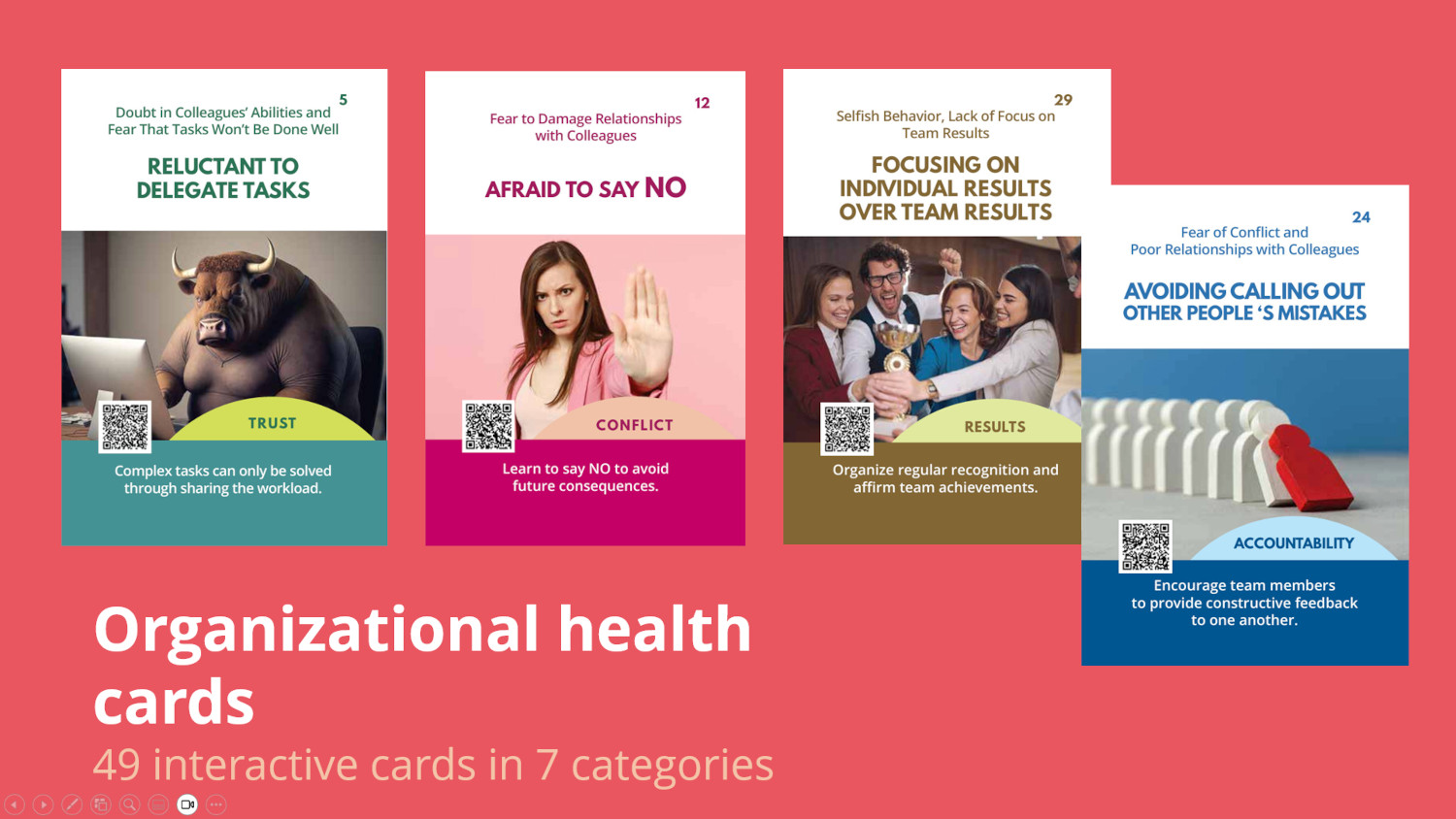
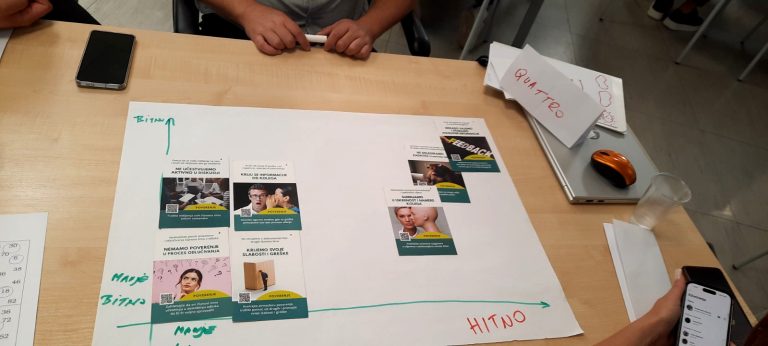
By placing the visual cards on the Urgent–Important matrix, you can quickly and easily set priorities and create an action plan.

From an interactive workshop in Belgrade
Contact us to schedule a meeting
Tel: + 381 65 26 080 26
Email: poslovnaznanja@gmail.com