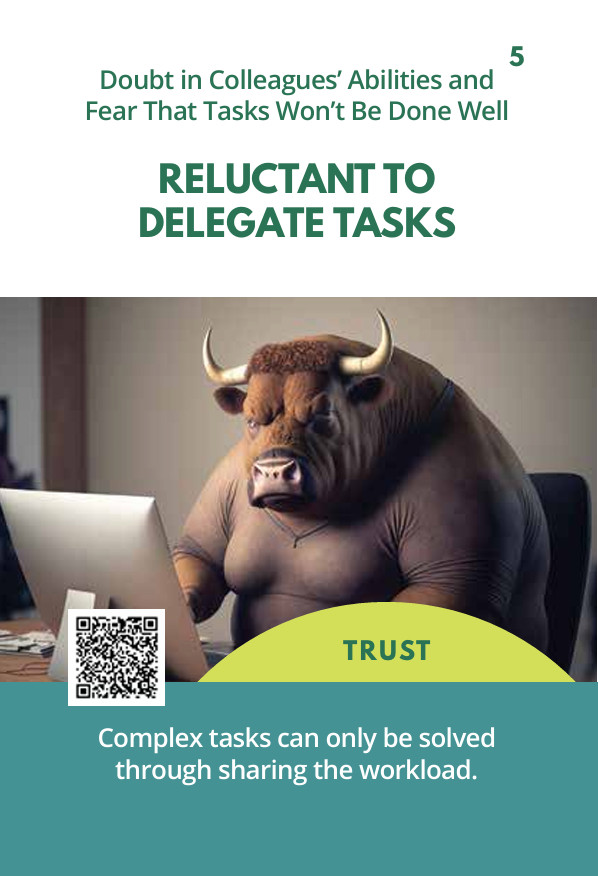
Reluctant to Delegate Tasks – TRUST – 5
When tasks are not delegated, trust is questioned and both leaders and teams become overloaded.
Where you’ll notice this in a team
This issue appears when responsibility remains concentrated in the hands of a few people, while others are underused or disengaged.- In daily work: one person becomes a bottleneck for decisions and execution.
- In leadership roles: managers do the work themselves instead of enabling others.
- In projects: tasks pile up with the same individuals.
- In deadlines: work slows down because approvals or inputs are delayed.
- In team morale: capable people feel underutilized or not trusted.
Why it happens
Reluctance to delegate is often driven by good intentions, but it usually signals a lack of trust.- Fear of losing control: “If I don’t do it myself, it won’t be done right.”
- Time pressure: delegating feels slower than doing it personally.
- Perfectionism: standards are not clearly communicated.
- Lack of confidence in others: skills or judgment are underestimated.
- Past failures: previous delegation attempts went poorly.
How it affects results
Teams that struggle with delegation often experience slower execution and limited growth.- leaders become overloaded and burned out,
- decisions are delayed,
- team capability develops slowly,
- initiative and ownership decline,
- engagement and motivation suffer.
How to reduce and overcome it
Effective delegation is not about giving up control, but about creating shared ownership and accountability.- Clarify expectations: define outcomes, not just tasks.
- Delegate progressively: start small and increase responsibility over time.
- Focus on results, not methods: allow different approaches.
- Provide support, not control: check in without micromanaging.
- Reflect and adjust: learn from each delegation experience.
Practical communication tools
These tools help leaders and teams make delegation clear, safe, and effective.- Outcome-based delegation: agree on what success looks like, not how to do the task.
- Delegation levels: clarify whether the person should inform, consult, or decide independently.
- Regular check-ins: short updates focused on progress and obstacles.
- Feedback loops: discuss what worked and what didn’t after completion.
- Capability mapping: match tasks to skills and development goals.
Recommended reading and resources
Improve Your Team Heath and Effectiveness
How can your team overcome hidden obstacles that slow it down?
Take our 3-day Organizational Health Improvement Workshop
- How can you identify specific problems and challenges in teamwork, cooperation, and internal communication among employees?
- How can you discover the root causes of these challenges and successfully solve them using our visual interactive “team effectiveness” cards?
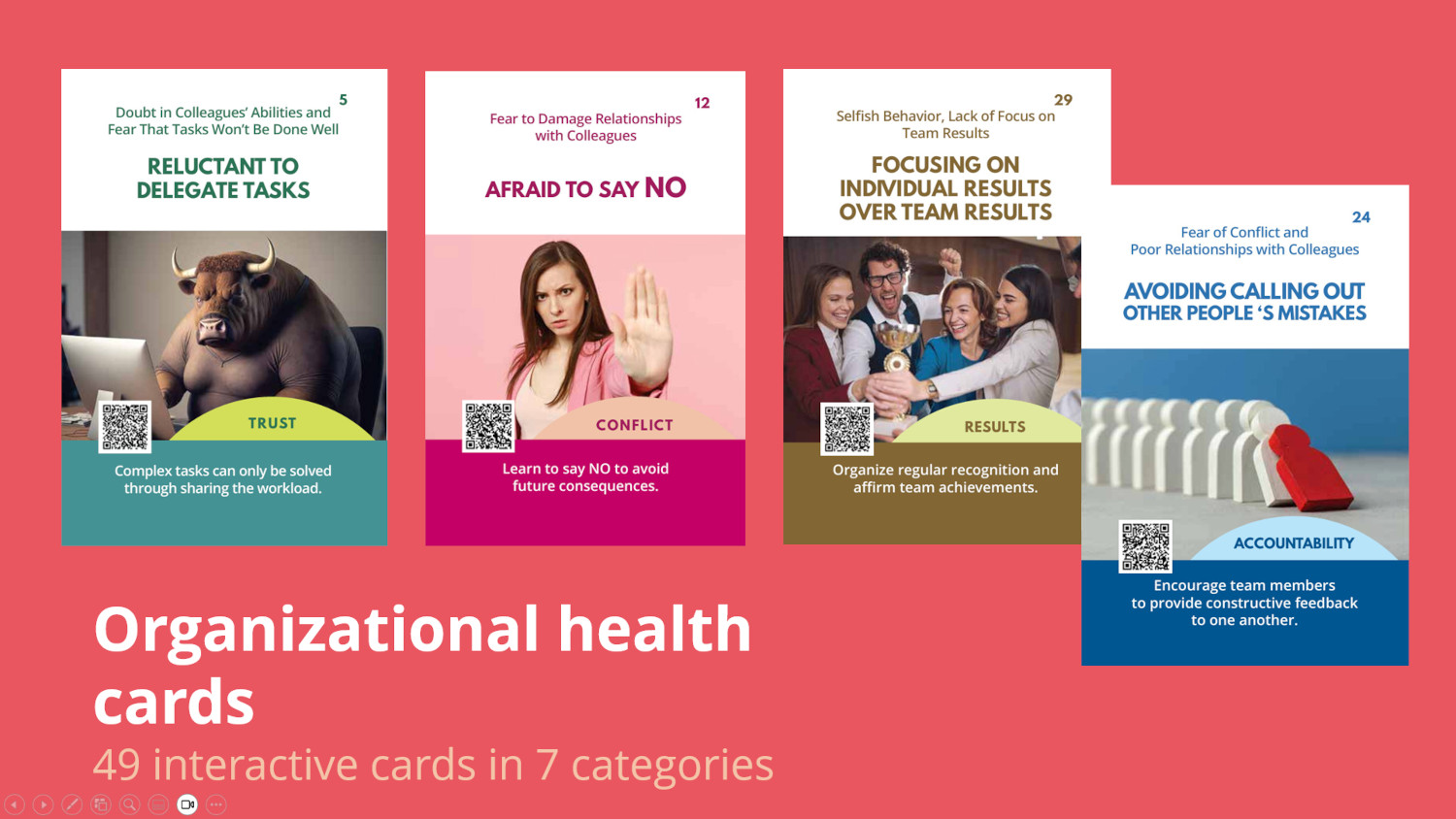
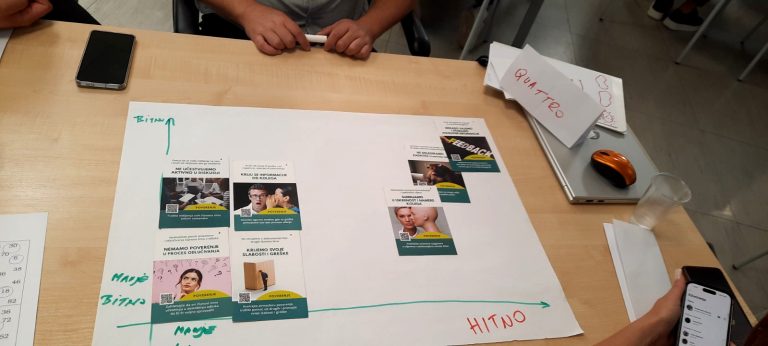
By placing the visual cards on the Urgent–Important matrix, you can quickly and easily set priorities and create an action plan.
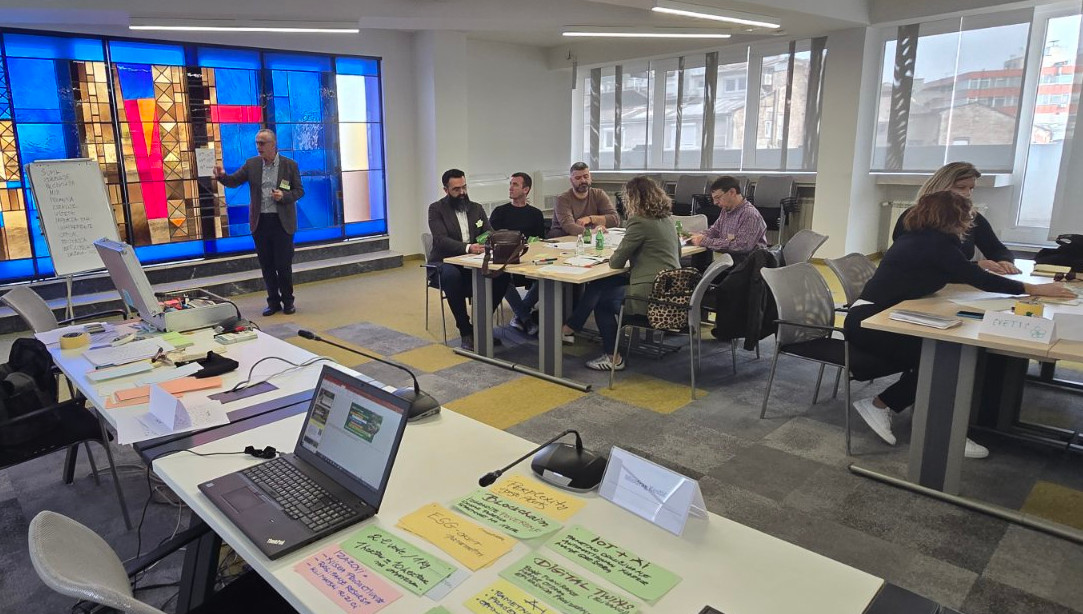
From an interactive workshop in Belgrade
Contact us to schedule a meeting
Tel: + 381 65 26 080 26
Email: poslovnaznanja@gmail.com