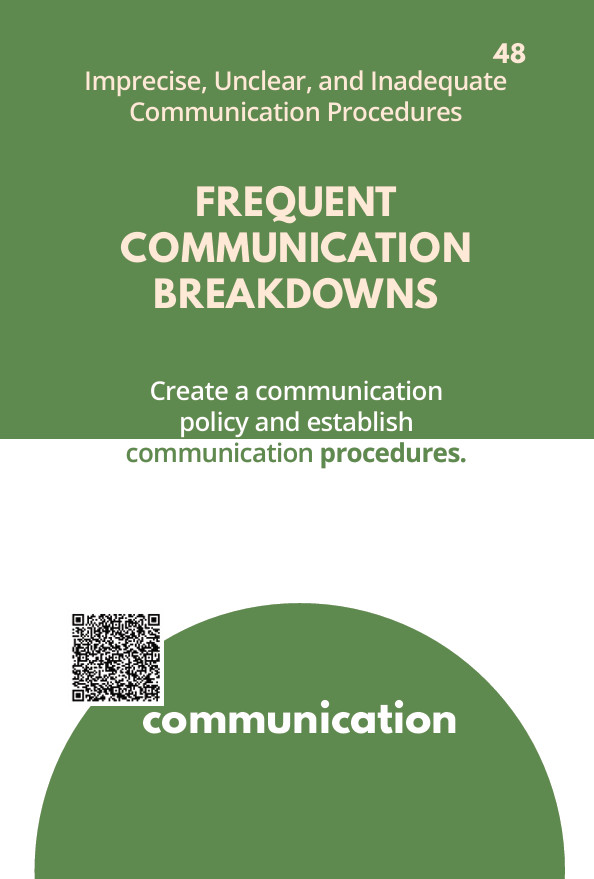
Frequent Communication Breakdowns – COMMUNICATION – 48
When communication breaks down frequently, teams lose alignment, messages are misunderstood or missed entirely, and collaboration becomes fragile, slow, and error-prone despite everyone’s best intentions.
Where you’ll notice this in everyday work
Communication breakdowns rarely happen as a single failure. They emerge through repeated small disconnects that accumulate across meetings, channels, and teams.
- Messages are interpreted differently by different people.
- Important details are lost between conversations or handovers.
- Teams rely on assumptions instead of shared understanding.
- Clarifications happen too late, often after mistakes.
- People say “that’s not what I meant” frequently.
- Work is duplicated because information didn’t reach everyone.
Over time, teams spend more effort fixing misunderstandings than doing meaningful work.
Why it happens
Communication breakdowns are usually systemic. They reflect unclear processes, overload, and mismatched communication habits.
- Too many channels: information is scattered and fragmented.
- Unclear ownership: no one ensures messages are understood.
- Overload: people filter out messages unintentionally.
- Lack of feedback loops: understanding is not checked.
- Assumption-driven communication: “everyone knows this already.”
Without deliberate structure, communication degrades under pressure.
How it affects results
Frequent communication breakdowns undermine both speed and quality.
- rework and inefficiency,
- missed deadlines and errors,
- frustration and blame between teams,
- loss of trust in communication channels,
- slower decision-making.
How to reduce and overcome it
Improving communication reliability requires simplifying, clarifying, and actively checking understanding.
- Reduce channels: define where specific information belongs.
- Clarify expectations: who communicates what, when, and how.
- Check understanding: don’t assume messages landed.
- Document key decisions: capture them in one visible place.
- Encourage questions: treat clarification as quality control.
Practical communication-stability tools
1) Communication Channel Map
Define which topics belong in which channel to reduce fragmentation and noise.
2) Message Confirmation Practice
Ask recipients to briefly confirm understanding, especially for complex or critical messages.
3) Single Source of Truth
Maintain one shared location for key decisions, updates, and documentation.
4) Post-Mortem Communication Reviews
After issues occur, review where communication failed and what should change next time.
Recommended links
Improve Your Team Heath and Effectiveness
How can your team overcome hidden obstacles that slow it down?
Take our 3-day Organizational Health Improvement Workshop
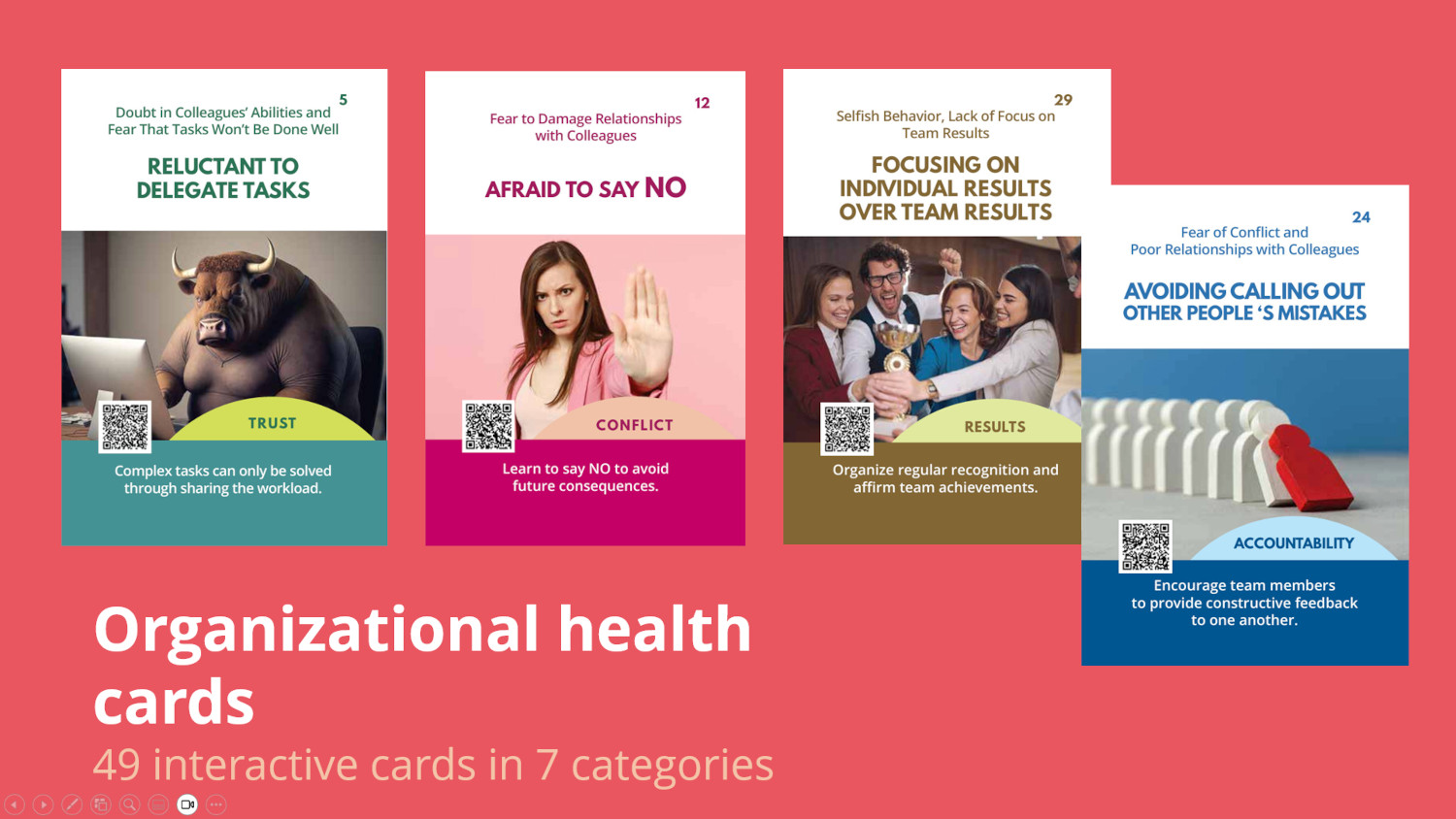
- How can you identify specific problems and challenges in teamwork, cooperation, and internal communication among employees?
- How can you discover the root causes of these challenges and successfully solve them using our visual interactive “team effectiveness” cards?
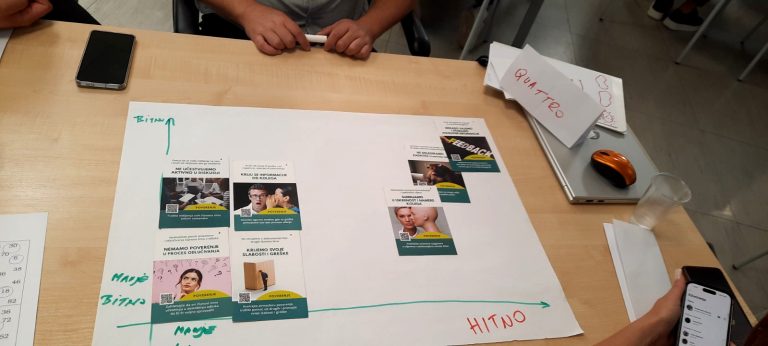
By placing the visual cards on the Urgent–Important matrix, you can quickly and easily set priorities and create an action plan.

From an interactive workshop in Belgrade
Contact us to schedule a meeting
Tel: + 381 65 26 080 26
Email: poslovnaznanja@gmail.com