Difficulty In Expressing Our Views – COMMUNICATION – 45
When people struggle to express their views clearly and confidently, valuable ideas remain unspoken, decisions are shaped by only a few voices, and teams miss opportunities to learn from diverse perspectives.

Where you’ll notice this in everyday work
Difficulty expressing views is often misinterpreted as lack of ideas or engagement. In reality, people frequently have opinions and insights but struggle to articulate them in group settings.
- People hesitate to speak up during meetings, especially in larger groups.
- Ideas are shared privately after meetings instead of openly.
- Strong personalities dominate discussions by default.
- Input is vague or overly cautious, lacking clarity or structure.
- Decisions feel one-sided because not all views were voiced.
- Frustration grows when people feel unheard or overlooked.
Over time, silence becomes habitual, and confidence in expressing opinions declines further.
Why it happens
Difficulty expressing views is rarely about communication ability alone. It usually stems from emotional, cultural, or contextual factors.
- Fear of negative reactions: criticism, dismissal, or conflict.
- Hierarchical pressure: senior voices carry more weight.
- Lack of structure: discussions feel chaotic or unsafe.
- Low confidence: people doubt the value of their input.
- Past experiences: previous attempts were ignored or shut down.
In such environments, self-censorship feels safer than contribution.
How it affects results
When people do not express their views, teams lose collective intelligence and resilience.
- decisions based on incomplete information,
- reduced innovation and creativity,
- lower engagement and ownership,
- hidden risks and blind spots,
- frustration and disengagement over time.
How to reduce and overcome it
Supporting people in expressing their views requires both psychological safety and clear structure.
- Create equal speaking space: actively invite quieter voices.
- Use structured formats: rounds, written input, or small groups.
- Separate ideas from evaluation: no immediate judgment.
- Acknowledge contributions: show that input has impact.
- Model openness: leaders share their own doubts and thinking.
Practical expression tools
1) Written-First Input
Ask participants to write down their views before discussing them aloud.
2) Round-Robin Sharing
Give each person equal time to speak without interruption or debate.
3) Small-Group Breakouts
People often express views more clearly in smaller, safer settings.
4) Opinion Framing Templates
Use simple structures such as: “I think…, because…, and I suggest…”
Recommended links
Improve Your Team Heath and Effectiveness
How can your team overcome hidden obstacles that slow it down?
Take our 3-day Organizational Health Improvement Workshop
- How can you identify specific problems and challenges in teamwork, cooperation, and internal communication among employees?
- How can you discover the root causes of these challenges and successfully solve them using our visual interactive “team effectiveness” cards?

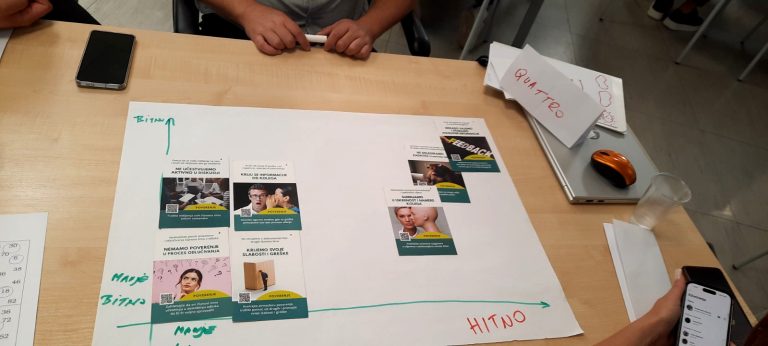
By placing the visual cards on the Urgent–Important matrix, you can quickly and easily set priorities and create an action plan.

From an interactive workshop in Belgrade
Contact us to schedule a meeting
Tel: + 381 65 26 080 26
Email: poslovnaznanja@gmail.com