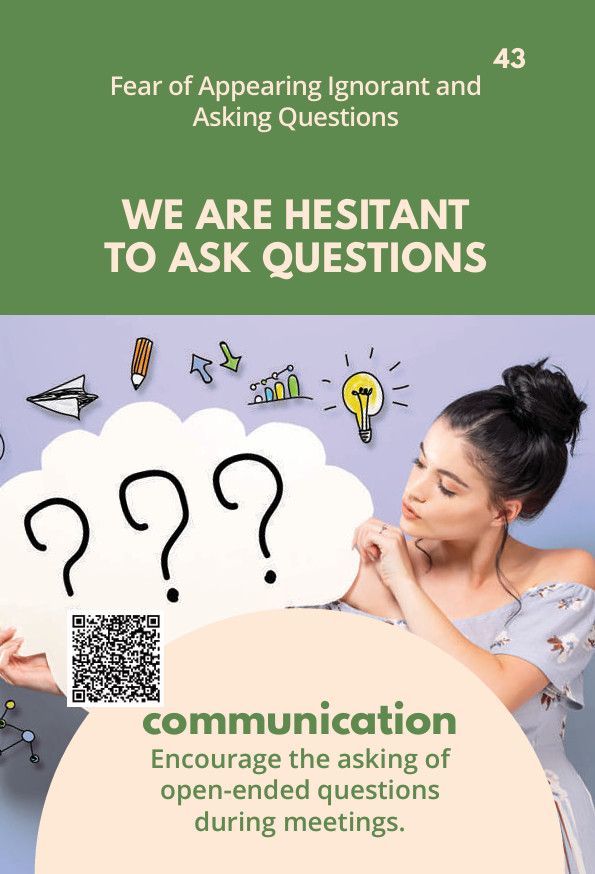
We Are Hesitant To Ask Questions – COMMUNICATION – 43
When people hesitate to ask questions, misunderstandings multiply, assumptions replace clarity, and teams lose opportunities to learn, improve, and prevent problems early.
Where you’ll notice this in everyday work
A lack of questions often creates the illusion of alignment. Meetings appear smooth, tasks are accepted quickly, but confusion surfaces later in execution.
- Meetings are quiet: few clarifying questions are asked.
- Instructions are accepted immediately but interpreted differently.
- People guess instead of checking, leading to rework.
- Junior team members stay silent even when confused.
- Problems appear late, when they are harder to fix.
- Feedback like “I didn’t know” appears after mistakes.
Over time, silence replaces curiosity, and learning slows across the team.
Why it happens
Hesitation to ask questions is rarely about lack of interest. It usually comes from fear, culture, or past experience.
- Fear of looking incompetent: questions are seen as weakness.
- Time pressure: asking feels like slowing others down.
- Hierarchical culture: questioning is perceived as challenging authority.
- Past negative reactions: questions were dismissed or ridiculed.
- Assumption of expectations: people believe they “should already know.”
In such environments, silence becomes the safest option.
How it affects results
When questions disappear, teams lose clarity, speed, and quality.
- misaligned expectations and outcomes,
- rework and unnecessary corrections,
- slower learning and onboarding,
- hidden risks and late surprises,
- reduced trust in communication.
How to reduce and overcome it
Encouraging questions requires intentional signals that curiosity is valued, not punished.
- Model curiosity: leaders ask questions first.
- Normalize clarification: treat questions as part of quality work.
- Create space for questions: explicitly pause and invite them.
- Reward early questions: highlight how they prevented problems.
- Respond respectfully: every question deserves a real answer.
Practical communication tools
1) “No Dumb Questions” Rule
Explicitly state that any clarification question is welcome, especially in planning and kickoff meetings.
2) Question Rounds
End meetings with a round where each person can ask one clarifying or “why” question.
3) Anonymous Question Channel
Provide a way to ask questions anonymously to surface uncertainties safely.
4) Assumption Checks
Regularly ask: “What assumptions are we making?” and validate them together.
Recommended links

Improve Your Team Heath and Effectiveness
How can your team overcome hidden obstacles that slow it down?
Take our 3-day Organizational Health Improvement Workshop
- How can you identify specific problems and challenges in teamwork, cooperation, and internal communication among employees?
- How can you discover the root causes of these challenges and successfully solve them using our visual interactive “team effectiveness” cards?

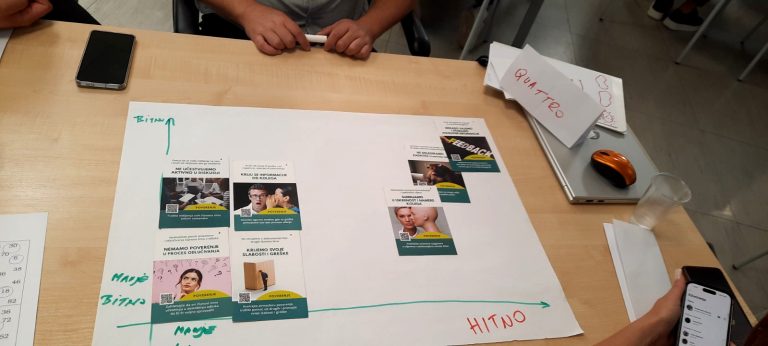
By placing the visual cards on the Urgent–Important matrix, you can quickly and easily set priorities and create an action plan.

From an interactive workshop in Belgrade
Contact us to schedule a meeting
Tel: + 381 65 26 080 26
Email: poslovnaznanja@gmail.com