Lack Of Personal Initiative – ORGANISATIONAL CULTURE – 40
When people rarely take initiative, teams become reactive instead of proactive, improvement slows down, and responsibility shifts upward, leaving leaders overloaded and employees disengaged.

Where you’ll notice this in everyday work
A lack of personal initiative is often misunderstood as laziness, but in reality it usually appears as excessive caution, passivity, or constant waiting for permission before acting.
- People wait for instructions even for routine or obvious next steps.
- Problems are noticed but not raised until someone explicitly asks.
- Ideas stay unspoken because “it’s not my role” or “it won’t matter anyway.”
- Opportunities are missed while teams wait for formal approval.
- Leaders become bottlenecks for decisions that could be handled lower.
- Change only happens when driven from the top.
Over time, initiative is replaced by compliance, and people focus on avoiding mistakes rather than creating value.
Why it happens
Low initiative is rarely a personality issue. It usually grows in environments where taking action feels risky, unrewarded, or even punished.
- Fear of making mistakes: errors are criticized more than learning is supported.
- Over-control: decisions are centralized, leaving little room to act.
- Unclear expectations: people don’t know where they are allowed to decide.
- Lack of recognition: initiative is not noticed or valued.
- Past negative experiences: previous attempts to take initiative were ignored or shut down.
In such systems, the safest behaviour becomes “wait and see.”
How it affects results
When initiative is missing, organizations lose speed, adaptability, and the ability to respond early to problems.
- slower decision-making and execution,
- overloaded managers and leaders,
- missed improvements and innovations,
- lower engagement and ownership,
- dependence on constant supervision.
How to reduce and overcome it
Encouraging initiative means creating clarity and safety, not simply telling people to “be more proactive.”
- Clarify decision boundaries: define what people can decide without approval.
- Normalize learning from mistakes: treat errors as feedback, not failure.
- Recognize initiative publicly: even when outcomes are imperfect.
- Reduce approval layers: shorten the distance between idea and action.
- Ask for proposals: instead of giving solutions, ask “What do you suggest?”
Practical tools to encourage initiative
1) Decision Rights Matrix (simple version)
Define which decisions individuals can make alone, which require consultation, and which need approval. This removes fear and hesitation.
2) “Two-Way Door” Rule
Encourage people to act quickly on reversible decisions and slow down only for irreversible ones.
3) Initiative Review Moments
Regularly ask: “Where did someone take initiative this month?” and discuss what helped or blocked that behaviour.
4) Coaching Questions Instead of Answers
Leaders respond to issues with questions rather than immediate solutions, building confidence and ownership over time.
Recommended links

Improve Your Team Heath and Effectiveness
How can your team overcome hidden obstacles that slow it down?
Take our 3-day Organizational Health Improvement Workshop
- How can you identify specific problems and challenges in teamwork, cooperation, and internal communication among employees?
- How can you discover the root causes of these challenges and successfully solve them using our visual interactive “team effectiveness” cards?

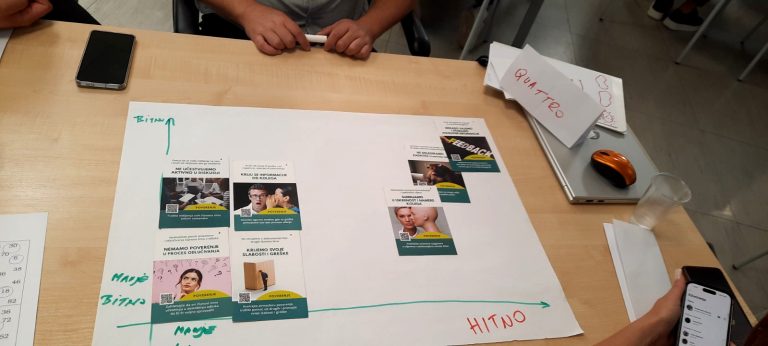
By placing the visual cards on the Urgent–Important matrix, you can quickly and easily set priorities and create an action plan.

From an interactive workshop in Belgrade
Contact us to schedule a meeting
Tel: + 381 65 26 080 26
Email: poslovnaznanja@gmail.com