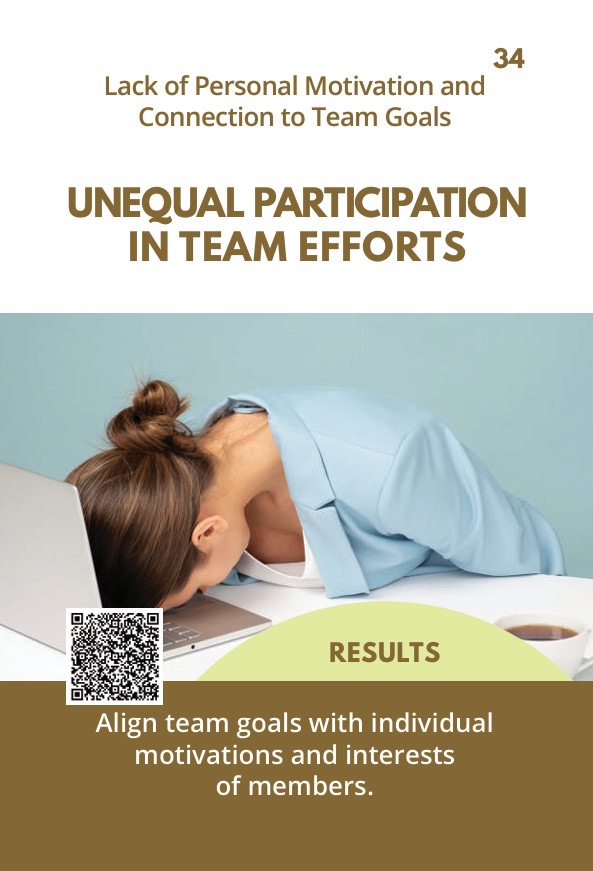
Unequal Participation In Team Efforts – RESULTS – 34
When only a few people carry the work, collaboration stops feeling like a team sport — and motivation quietly drops.
Where you’ll notice this in a team
This issue is rarely “one big moment.” It shows up in small, repeatable patterns that slowly become normal:
- Same people speak, decide, and volunteer: a few voices dominate meetings, while others stay passive or “agree with everything.”
- Workload always lands on the reliable ones: the same teammates take the hardest tasks, chase updates, and rescue deadlines.
- Uneven ownership: some tasks have clear owners, while others float around until a “hero” picks them up.
- Last-minute panic: quiet team members appear engaged only when the deadline is close, or when someone asks directly.
- Hidden resentment: high performers feel exploited; others feel judged or excluded — and nobody says it openly.
- Quality gap: some deliverables are solid and on time, while others are late, incomplete, or need rework.
Why it happens
Unequal participation is often misread as “lazy people.” In reality, it usually grows from a combination of team habits and unclear expectations:
- Roles and responsibilities are fuzzy: when ownership isn’t explicit, people naturally assume “someone else will handle it.”
- Different confidence levels: some teammates hesitate because they fear mistakes, criticism, or “looking stupid.”
- Unequal power or safety: if certain people are always right (or loud), others learn to stay quiet.
- Leaders reward hero behaviour: when the “rescuer” is praised, the system trains everyone to rely on them.
- Low visibility: contributions aren’t tracked, so effort stays invisible and accountability becomes optional.
- Overloaded or disengaged members: some people may be stuck in too many tasks, confused about priorities, or emotionally checked out.
In many teams, this becomes a loop: the strongest contributors step in to keep things moving, which unintentionally gives others fewer chances to learn, lead, or take responsibility. Over time, it creates frustration, burnout, and lower overall results.
How to reduce and overcome it
The goal isn’t “force everyone to contribute equally every day.” The goal is fairness, clarity, and shared ownership — so the team can perform without heroes and without passengers.
- Make ownership visible: for each task, define one owner (responsible), one deadline, and one “definition of done.” Avoid shared ownership without a named lead.
- Agree on team contribution rules: simple norms like “everyone speaks once before anyone speaks twice” or “no meeting ends without owners for next steps.”
- Break work into smaller commitments: some people don’t engage because tasks feel too big or risky. Smaller tasks + shorter deadlines increase participation.
- Rotate responsibility on purpose: rotate who runs the weekly meeting, who presents updates, who documents decisions, and who follows up — so contribution becomes a habit.
- Address patterns early: talk about the pattern, not the person. Example: “We rely on the same two people for delivery — how do we redesign the workload?”
- Coach, don’t rescue: when someone struggles, support them with clear expectations, checklists, and feedback — but don’t take the task back unless necessary.
Practical communication tools
1) “Participation Map” (10-minute team check)
Once per week (or per sprint), do a fast review with two questions:
- Who carried the most load this week? (facts only: tasks, hours, pressure)
- Who had the least clear ownership or opportunity to contribute? (and why)
End by choosing one re-balance action for the next week (e.g., assign ownership differently, pair people, split one big task into 3 smaller ones).
2) RACI-lite (clarity without bureaucracy)
For any task that keeps bouncing around, write 4 lines (even in a chat message):
- Responsible: who does the work
- Accountable: who signs off / owns the outcome
- Consulted: who must be asked before finalizing
- Informed: who needs the update
This quickly stops the “everyone thought someone else was doing it” problem — and it prevents overloading the same people by default.
3) “One Step Up” delegation script (for leaders and seniors)
When you want someone else to take ownership (without dumping it), use this structure:
- Outcome: “Here’s what success looks like…”
- Boundaries: “You can decide X and Y; for Z, check with me.”
- Support: “Here are the resources / examples / contacts.”
- Checkpoints: “Let’s sync on progress on (date).”
This increases participation because people know what to do, what they’re allowed to decide, and when they’ll get feedback.
4) Meeting facilitation rule: “everyone contributes”
Use a simple technique in meetings where participation is uneven:
- Start with 60–90 seconds of silent thinking and writing.
- Round-robin: each person shares one point (no interruptions).
- Only then open discussion.
This removes the “fastest voice wins” dynamic and gives quieter members a fair entry into the conversation.
Recommended links
- Atlassian Team Playbook – practical plays for healthier collaboration
- Google re:Work – evidence-based practices for teams and managers
- Harvard Business Review – teams and collaboration (articles and tools)
- MindTools – delegation, accountability, and teamwork techniques
- Scrum.org Resources – shared ownership, roles, and team delivery practices
Improve Your Team Heath and Effectiveness
How can your team overcome hidden obstacles that slow it down?
Take our 3-day Organizational Health Improvement Workshop
- How can you identify specific problems and challenges in teamwork, cooperation, and internal communication among employees?
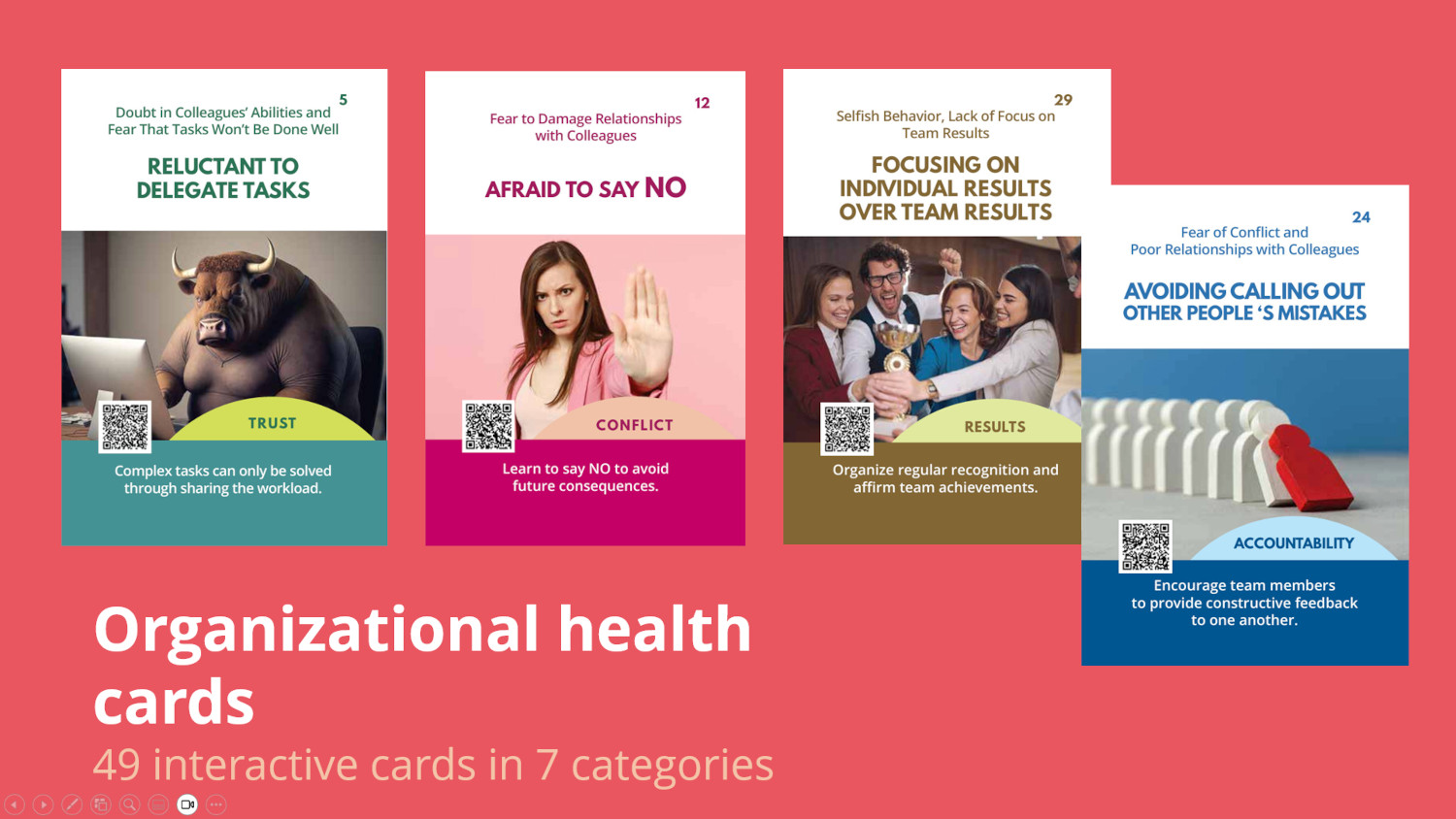
- How can you discover the root causes of these challenges and successfully solve them using our visual interactive “team effectiveness” cards?
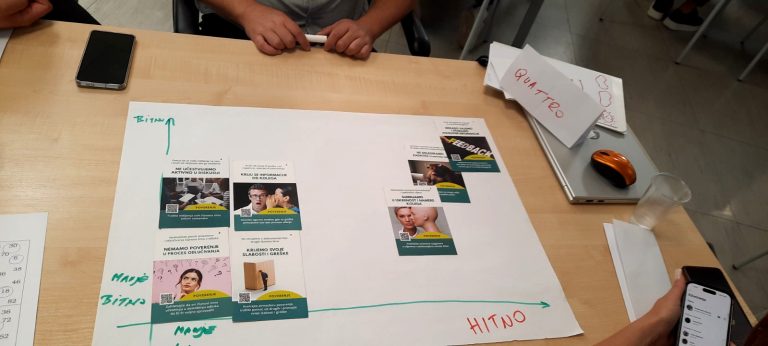
By placing the visual cards on the Urgent–Important matrix, you can quickly and easily set priorities and create an action plan.
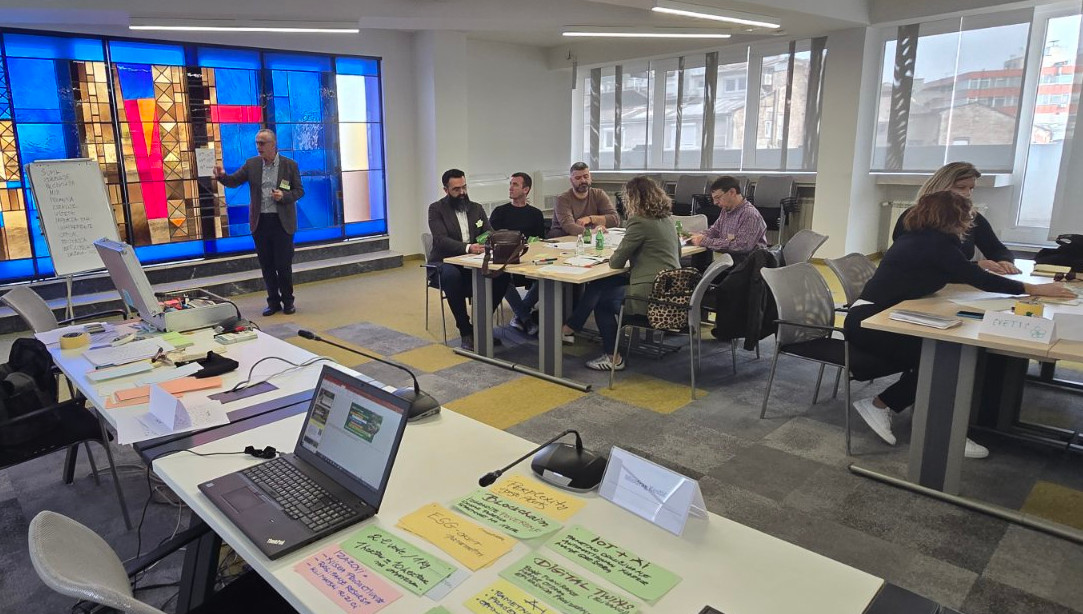
From an interactive workshop in Belgrade
Contact us to schedule a meeting
Tel: + 381 65 26 080 26
Email: poslovnaznanja@gmail.com