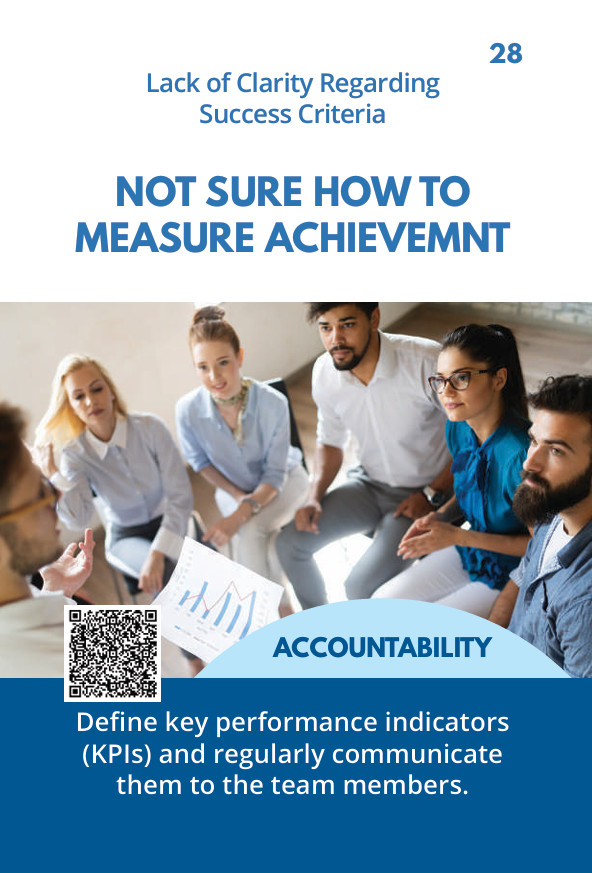
Not Sure How To Measure Achievement – ACCOUNTABILITY – 28
When teams are unclear about how success is measured, effort increases but results remain inconsistent, frustrating, and hard to evaluate.
What this looks like in everyday work
Teams often work hard but still feel unsure whether they are actually successful. Progress is discussed, but achievement is vague.
- People are busy but can’t explain what “good” looks like.
- Different stakeholders use different success criteria.
- Feedback is subjective and inconsistent.
- Reviews feel unfair because expectations were never clear.
- Achievements are debated instead of celebrated.
Without clear measures, teams rely on opinions instead of evidence.
Why it happens
Unclear measurement usually comes from weak alignment between goals, metrics, and daily work.
- Goals are too abstract: “do your best” is not measurable.
- Metrics change frequently: success keeps moving.
- Outputs and outcomes are mixed: activity replaces impact.
- Measurement is avoided: fear of accountability.
- No shared definition: teams never agreed on success.
When success is unclear, accountability becomes impossible.
How it affects results
Without clear measures, teams struggle to improve consistently.
- confusion and misaligned priorities,
- lower motivation and engagement,
- ineffective performance discussions,
- difficulty learning from results,
- reduced accountability.
How to reduce and overcome it
Measurement should clarify work, not control it. Clear criteria support focus, ownership, and improvement.
- Define success clearly: agree on outcomes, not effort.
- Limit metrics: fewer measures create clarity.
- Connect work to results: show cause and effect.
- Review regularly: adjust measures when needed.
- Make results visible: transparency builds ownership.
Practical tools (explained)
1) Success definition workshop
Teams explicitly define what success means for a task or project.
How to use it: answer “How will we know we succeeded?”
2) Outcome vs activity mapping
Separate what people do from what actually matters.
How to use it: link activities to measurable outcomes.
3) Simple scorecards
Track a small number of key indicators consistently.
How to use it: review scorecards in team meetings.
4) Retrospective questions
Use reflection to improve future measurement.
How to use it: ask “What did results tell us?”
Recommended links
Improve Your Team Heath and Effectiveness
How can your team overcome hidden obstacles that slow it down?
Take our 3-day Organizational Health Improvement Workshop
- How can you identify specific problems and challenges in teamwork, cooperation, and internal communication among employees?
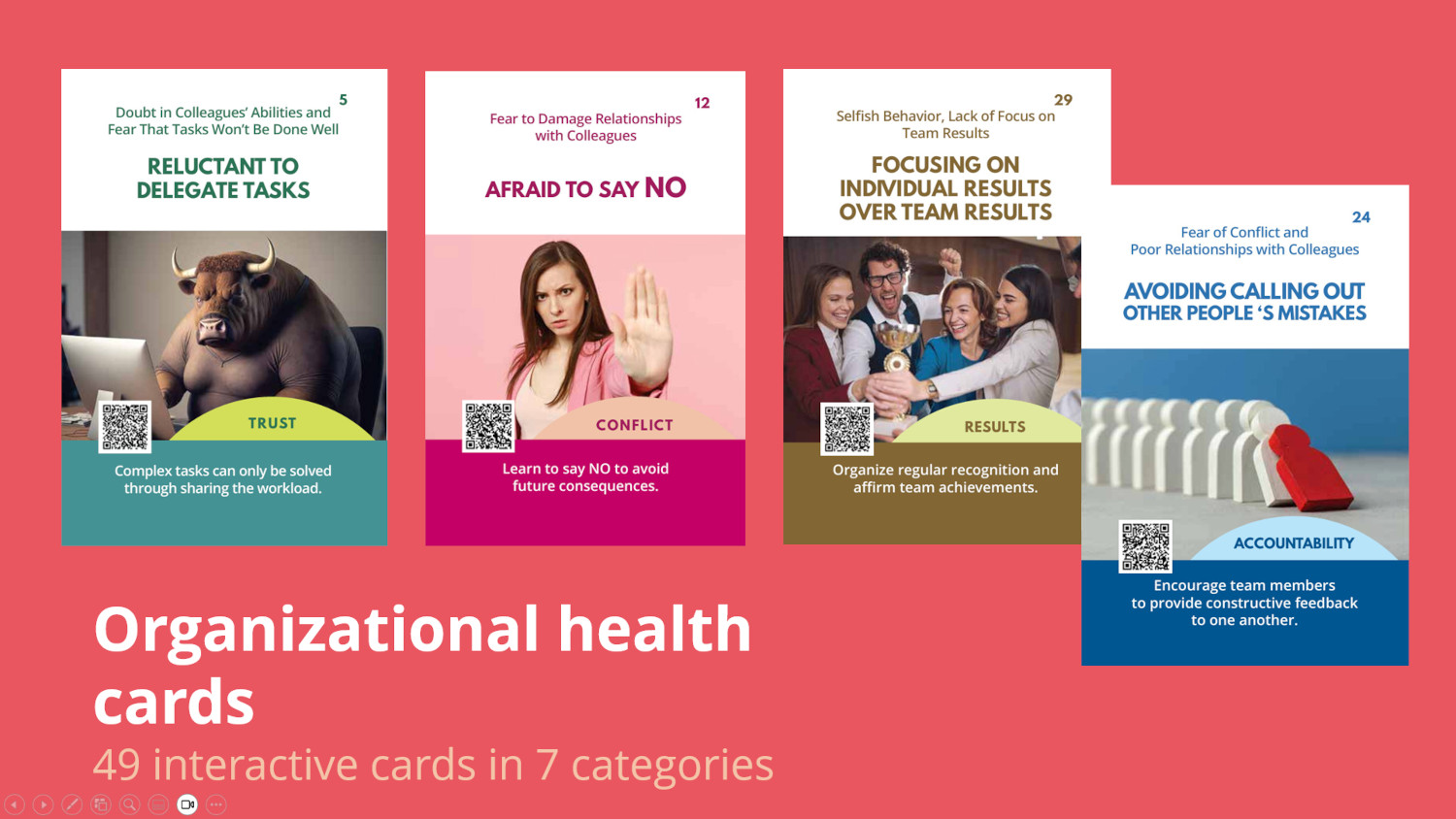
- How can you discover the root causes of these challenges and successfully solve them using our visual interactive “team effectiveness” cards?
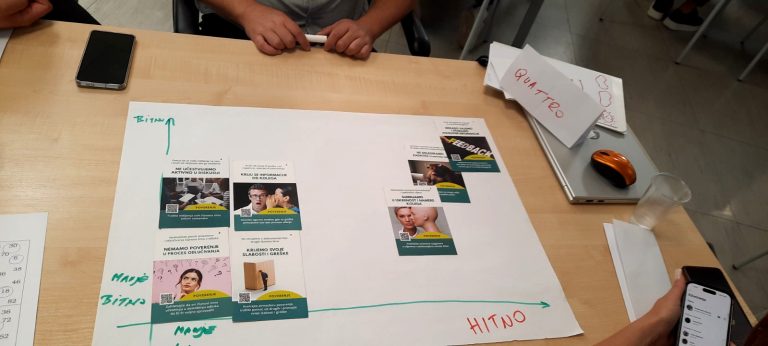
By placing the visual cards on the Urgent–Important matrix, you can quickly and easily set priorities and create an action plan.
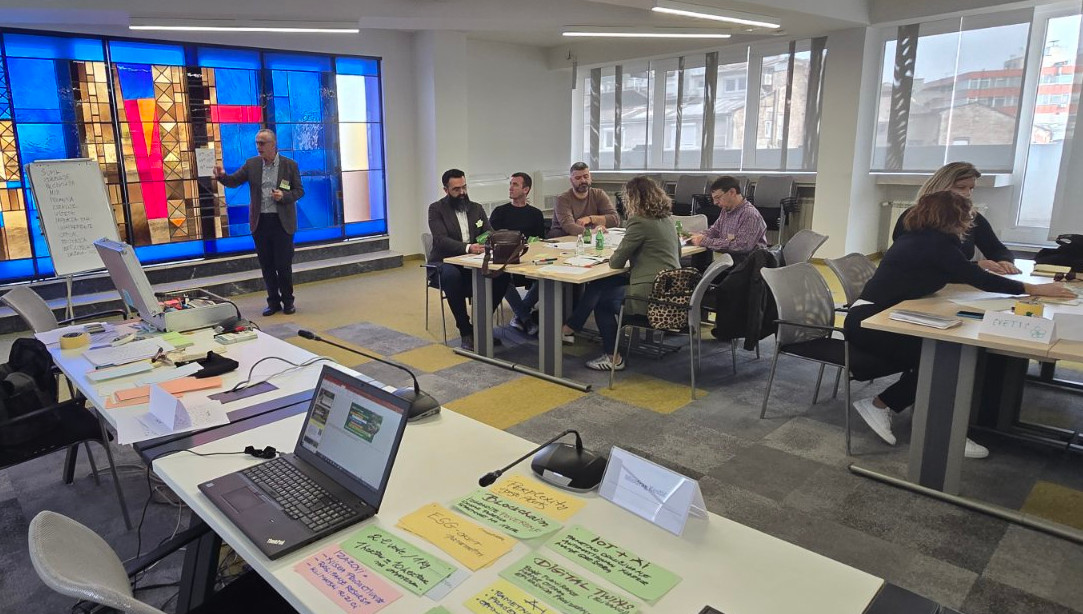
From an interactive workshop in Belgrade
Contact us to schedule a meeting
Tel: + 381 65 26 080 26
Email: poslovnaznanja@gmail.com