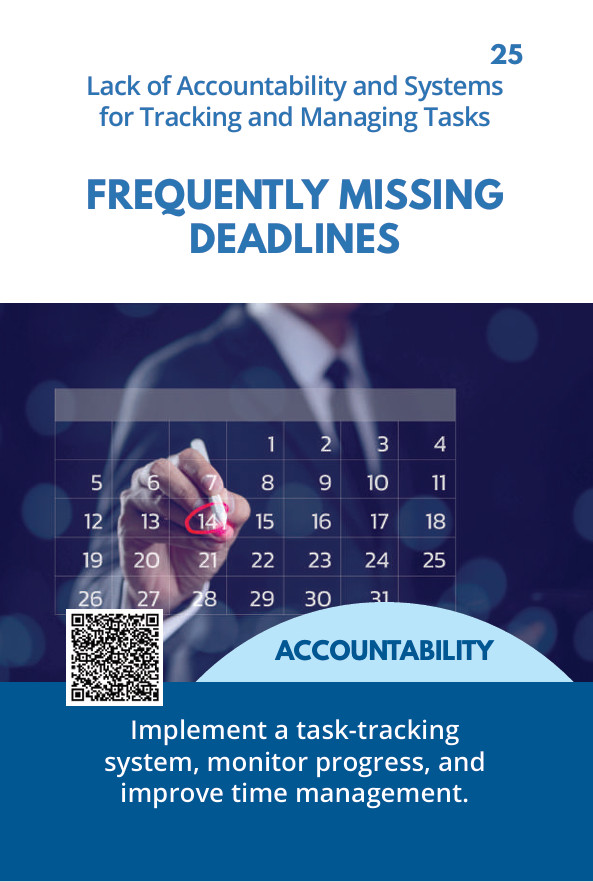
Frequently Missing Deadlines – NO ACCOUNTABILITY – 25
When deadlines are repeatedly missed, accountability weakens, trust erodes, and teams shift from planning to constant recovery mode.
What this looks like in everyday work
Missed deadlines are often treated as isolated incidents, but in reality they usually form a pattern. Teams still work hard, but delivery becomes unpredictable and reactive.
- Deadlines are “moved” rather than discussed openly.
- Delays are explained with external reasons, not addressed internally.
- Follow-up pressure increases near the deadline.
- Last-minute rushes become normal.
- Other teams or clients stop relying on promised delivery dates.
Over time, deadlines lose their meaning and become suggestions instead of commitments.
Why it happens
Missed deadlines are rarely caused by a single factor. They usually result from a combination of planning, communication, and accountability issues.
- Unrealistic planning: timelines are set without checking capacity.
- Unclear ownership: no one feels personally responsible for delivery.
- Late escalation: problems are raised only when it’s too late.
- Competing priorities: new work replaces agreed commitments.
- Lack of consequences: missed deadlines have no real impact.
When delays are tolerated, they quickly become the norm.
How it affects results
Consistently missed deadlines damage performance even when final results eventually arrive.
- loss of trust from colleagues and stakeholders,
- increased stress and burnout,
- lower perceived professionalism,
- inefficient rework and firefighting,
- weakened accountability culture.
How to reduce and overcome it
Improving deadline reliability requires realism, ownership, and early communication — not pressure.
- Plan with capacity in mind: confirm availability before committing.
- Assign one accountable owner: shared responsibility leads to missed deadlines.
- Break work into milestones: track progress early.
- Escalate risks early: delays are easier to fix before they happen.
- Review missed deadlines: focus on causes, not excuses.
When deadlines are treated as commitments, reliability improves naturally.
Practical tools (explained)
1) Deadline ownership statement
End planning discussions with a clear commitment: “[Name] is accountable for delivery by [date].”
How to use it: make deadlines explicit and visible to the whole team.
2) Milestone tracking
Break deadlines into intermediate checkpoints to detect delays early.
How to use it: review milestone status weekly, not just final delivery.
3) Early warning rule
Agree that potential delays must be reported as soon as they appear.
How to use it: reward early warnings, even if the news is bad.
4) Deadline review loop
Review missed deadlines with one question: “What will we change next time?”
How to use it: document lessons learned and adjust planning.
Recommended links
- Harvard Business Review – meeting deadlines
- MindTools – time management and deadlines
- Google re:Work – productivity and execution
- Atlassian – project management basics
- Poslovna Znanja – execution & accountability workshops

Improve Your Team Heath and Effectiveness
How can your team overcome hidden obstacles that slow it down?
Take our 3-day Organizational Health Improvement Workshop
- How can you identify specific problems and challenges in teamwork, cooperation, and internal communication among employees?
- How can you discover the root causes of these challenges and successfully solve them using our visual interactive “team effectiveness” cards?

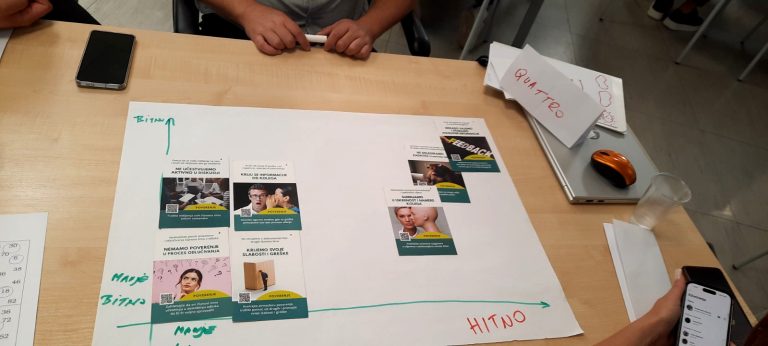
By placing the visual cards on the Urgent–Important matrix, you can quickly and easily set priorities and create an action plan.

From an interactive workshop in Belgrade
Contact us to schedule a meeting
Tel: + 381 65 26 080 26
Email: poslovnaznanja@gmail.com