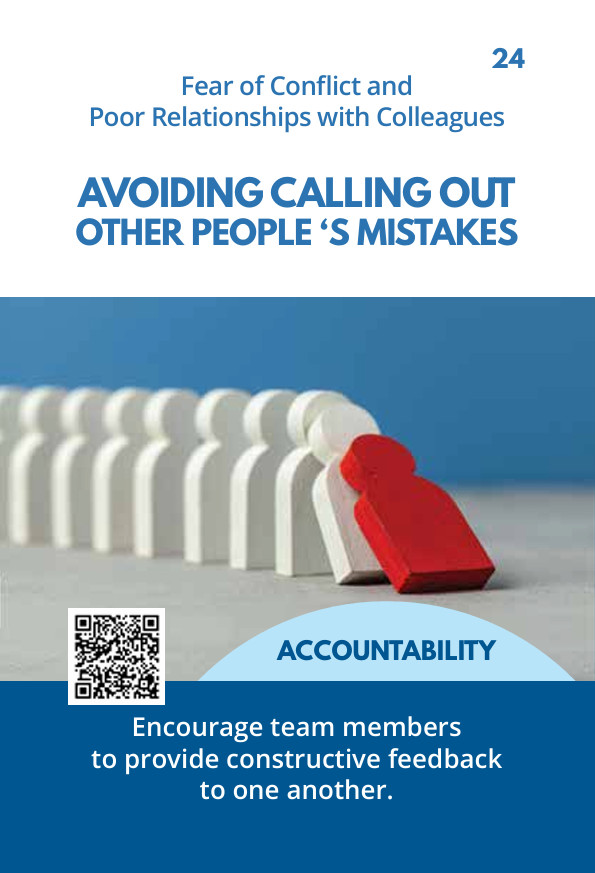
Avoiding Calling Out Other People sMistakes – ACCOUNTABILITY – 24
When mistakes are noticed but not addressed, problems repeat, standards drop, and accountability quietly fades.
What this looks like in everyday work
In teams where mistakes are not pointed out, people often see problems early — but choose to stay silent. The intention is usually positive: to avoid conflict, embarrassment, or uncomfortable conversations.
- Errors are noticed but ignored because “it’s not my place.”
- Small mistakes repeat and gradually become normal.
- Quality issues surface late, often when fixing them is costly.
- Feedback is given indirectly or behind people’s backs.
- Standards erode without anyone explicitly lowering them.
Over time, silence replaces responsibility, and problems grow quietly.
Why it happens
Not pointing out mistakes is rarely about indifference. It is more often about fear and uncertainty.
- Fear of conflict: people don’t want to upset colleagues.
- Fear of being seen as critical: especially in “nice” cultures.
- Unclear authority: people don’t know if it’s their role.
- Past negative reactions: feedback was taken personally.
- Lack of skill: people don’t know how to give constructive feedback.
When pointing out mistakes feels risky, silence feels safer.
How it affects results
Teams that avoid addressing mistakes pay a high price over time, even if short-term harmony is preserved.
- repeated errors and quality problems,
- lower standards and reduced professionalism,
- frustration among people who care about quality,
- loss of trust in feedback processes,
- weak accountability and learning.
How to reduce and overcome it
Addressing mistakes does not mean criticizing people. It means protecting quality, learning, and shared responsibility.
- Normalize feedback: treat it as part of daily work.
- Focus on behavior and impact: not personality.
- Encourage early correction: small fixes prevent big failures.
- Create psychological safety: make feedback safe to give and receive.
- Lead by example: leaders invite feedback on their own mistakes.
When mistakes are addressed early and respectfully, teams improve faster and trust grows.
Practical tools (explained)
1) SBIC feedback structure
Use a simple structure to point out mistakes without personal attacks: Situation, Behavior, Impact, Correction.
How to use it: keep feedback factual, short, and focused on improvement.
2) “Fix it early” rule
Agree that mistakes should be addressed as soon as they are noticed, not saved for performance reviews.
How to use it: correct small issues within 24–48 hours.
3) Permission to point out issues
Explicitly give team members permission to point out mistakes, regardless of role or seniority.
How to use it: leaders state this rule publicly and repeat it often.
4) Learning-focused correction
When mistakes are pointed out, always add a learning question: “What should we do differently next time?”
How to use it: document improvements, not blame.
Recommended links
Improve Your Team Heath and Effectiveness
How can your team overcome hidden obstacles that slow it down?
Take our 3-day Organizational Health Improvement Workshop
- How can you identify specific problems and challenges in teamwork, cooperation, and internal communication among employees?
- How can you discover the root causes of these challenges and successfully solve them using our visual interactive “team effectiveness” cards?
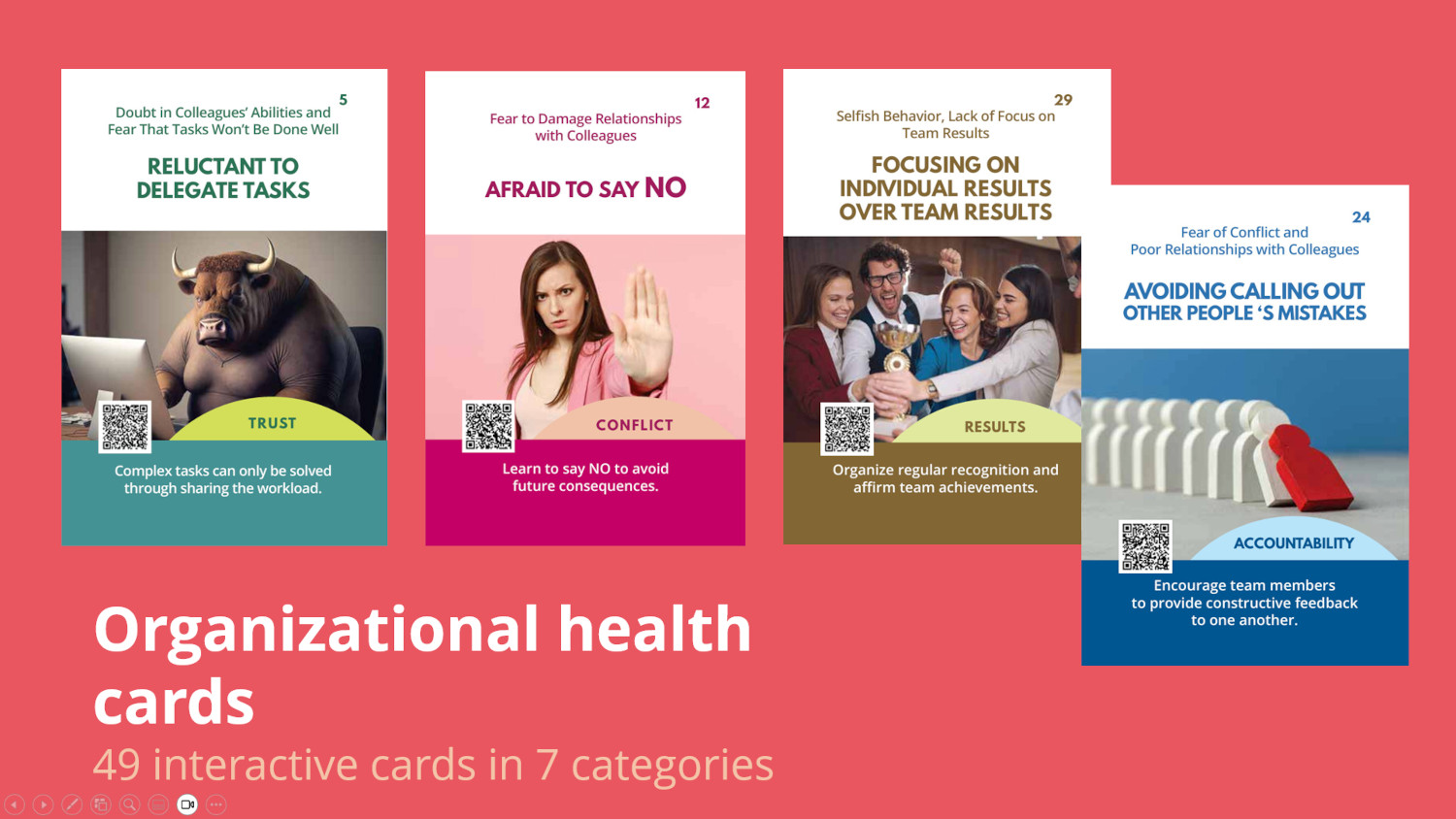
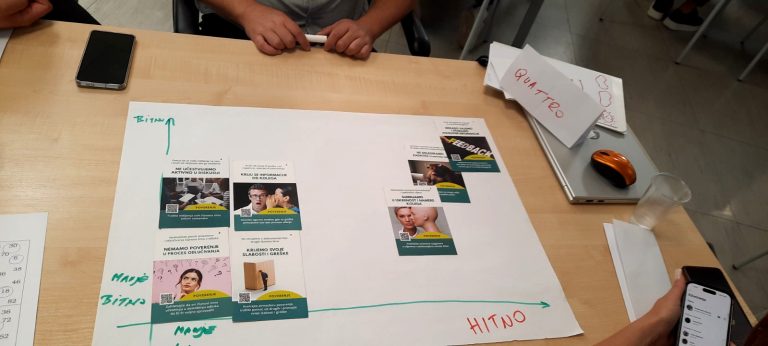
By placing the visual cards on the Urgent–Important matrix, you can quickly and easily set priorities and create an action plan.
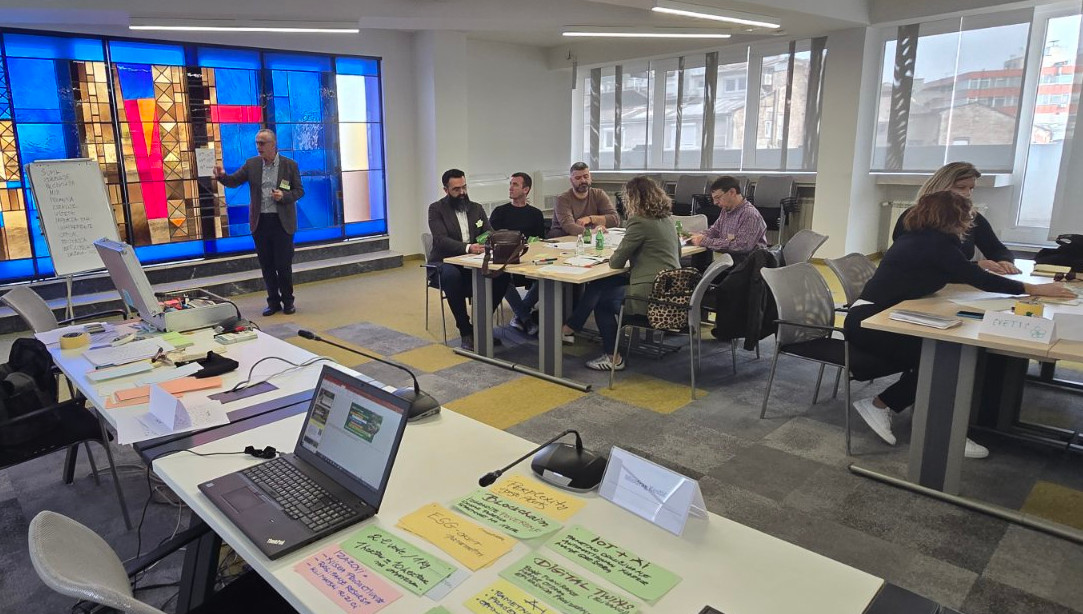
From an interactive workshop in Belgrade
Contact us to schedule a meeting
Tel: + 381 65 26 080 26
Email: poslovnaznanja@gmail.com