We Prefer Working Alone – COMMITMENT – 21
When people avoid collaboration, teams lose shared ownership, learning slows down, and results depend too much on individual effort.

What this looks like in everyday work
Preferring to work alone doesn’t mean people dislike others. In many teams, individuals choose solo work because it feels faster, safer, or more controllable than collaboration.
- People solve problems individually instead of involving the team.
- Information stays in personal notes or inboxes, not shared spaces.
- Collaboration happens late, often only to “inform,” not to co-create.
- Meetings are seen as interruptions, not opportunities.
- Success is described in individual terms, not team outcomes.
Over time, teamwork becomes optional, not expected.
Why it happens
Preference for solo work usually develops as a response to past experiences, not because people reject teamwork by default.
- Low trust: people fear criticism or interference.
- Inefficient meetings: collaboration feels like wasted time.
- Unclear roles: teamwork creates confusion instead of clarity.
- Performance systems: rewards focus on individual results.
- Overload: collaborating feels slower under pressure.
When collaboration costs more energy than it saves, people naturally avoid it.
How it affects results
Teams that work in parallel instead of together struggle to scale and adapt.
- duplicated work and inconsistent solutions,
- knowledge silos and dependency on individuals,
- limited learning and innovation,
- weak shared ownership,
- reduced resilience when key people are absent.
How to reduce and overcome it
Collaboration improves when it is purposeful, structured, and clearly valuable.
- Clarify when collaboration is required: not everything needs group work.
- Design better meetings: focus on decisions and co-creation.
- Create shared goals: make success collective, not individual.
- Reduce friction: use simple tools for sharing and co-working.
- Model collaboration: leaders collaborate visibly.
Practical tools (explained)
1) Collaboration trigger rule
Define clear moments when collaboration is mandatory (e.g., cross-team impact, customer-facing decisions, risk).
How to use it: write 3–5 triggers and make them visible to everyone.
2) Co-creation sessions
Replace long updates with short sessions focused on joint problem-solving.
How to use it: 60–90 minutes, clear problem statement, concrete output.
3) Shared workspace standard
Agree on where work-in-progress lives so collaboration is easy.
How to use it: one shared tool, one structure, one rule: “If it’s not there, it doesn’t exist.”
4) Team outcome review
Review results as a team, not as individuals.
How to use it: ask “What did we achieve together?” before “Who did what?”
Recommended links
Improve Your Team Heath and Effectiveness
How can your team overcome hidden obstacles that slow it down?
Take our 3-day Organizational Health Improvement Workshop
- How can you identify specific problems and challenges in teamwork, cooperation, and internal communication among employees?
- How can you discover the root causes of these challenges and successfully solve them using our visual interactive “team effectiveness” cards?
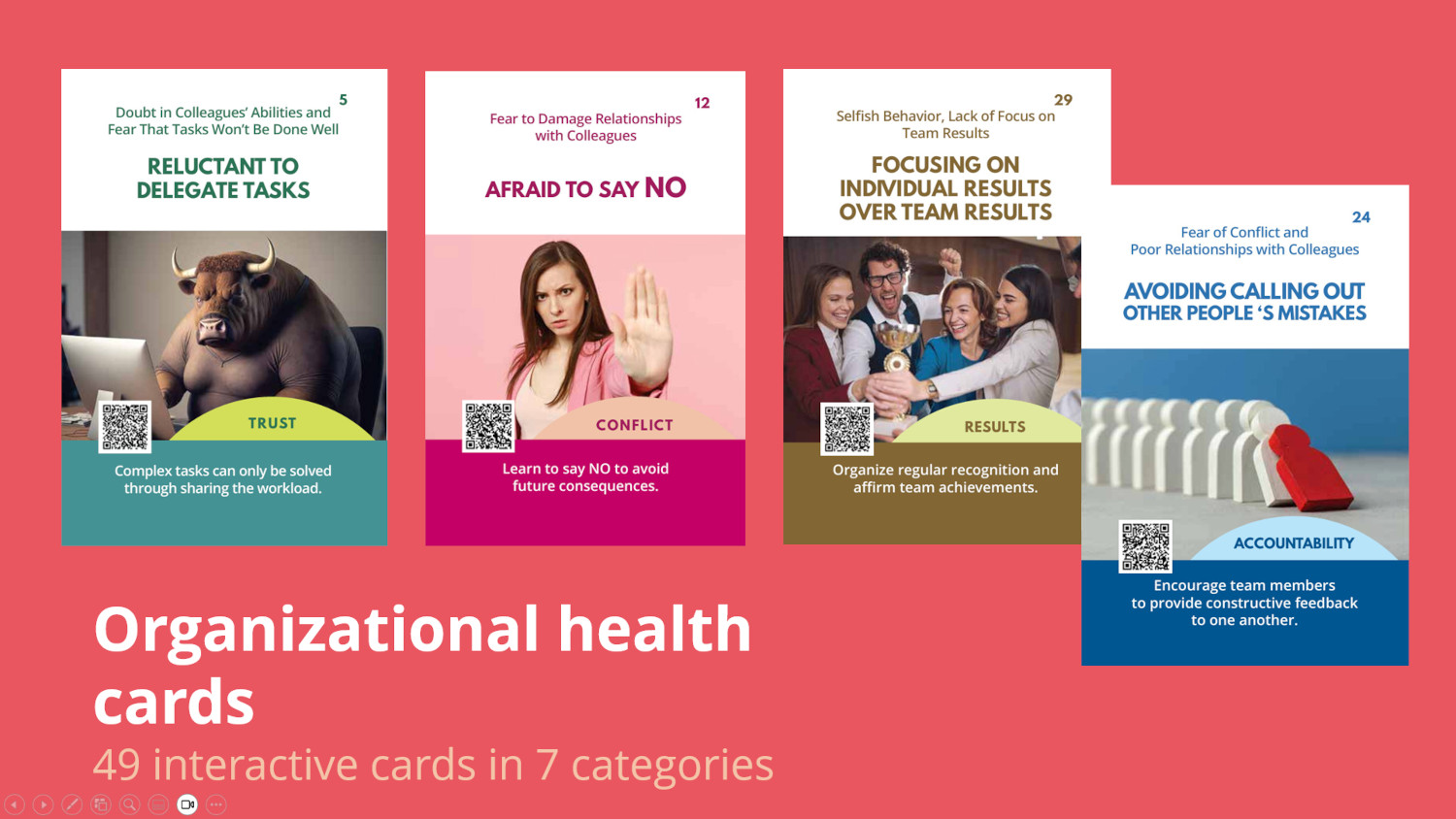
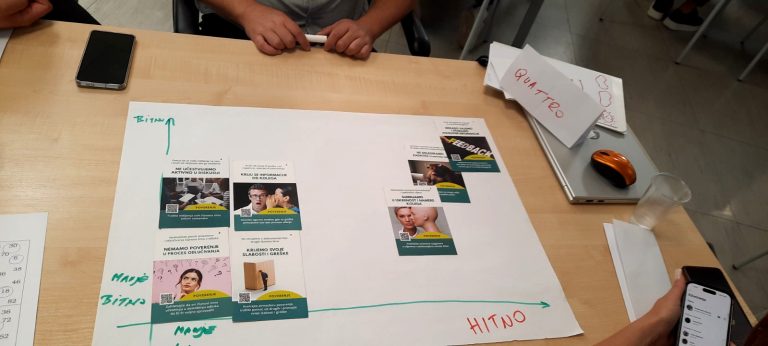
By placing the visual cards on the Urgent–Important matrix, you can quickly and easily set priorities and create an action plan.
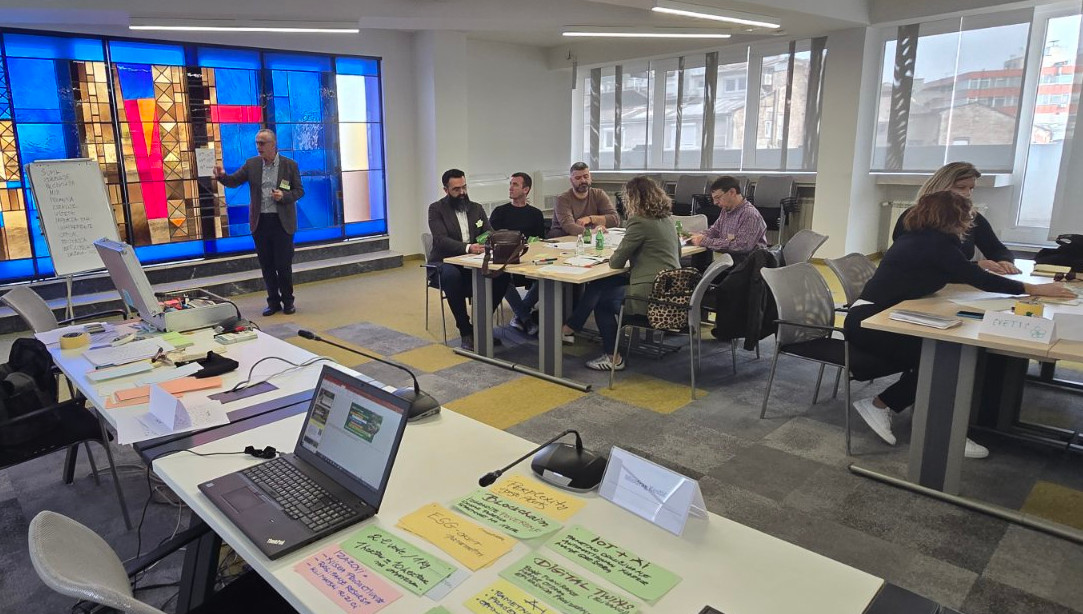
From an interactive workshop in Belgrade
Contact us to schedule a meeting
Tel: + 381 65 26 080 26
Email: poslovnaznanja@gmail.com